How to lay a knife mark that stands up in relief and keeps its edges, with the knife you already own, having never known how to handle it.
This book is worked in acrylic, not in watercolor and not in oil, on a support that does not bend: a blade lays nothing down unless the paint stands up on it. Better you know that before the first line, and before you decide anything at all on this page.
"I often scrape the paint and it turns into a mess very fast." It is not the blade, it is not the paint, and it is not the hand. A knife mark is decided in four stages, in this order: the load, the press, the relief, the lift. All four get settled before the metal touches the support, and that is why a mark that has failed gets caught up on the next pass, never while you are laying it.
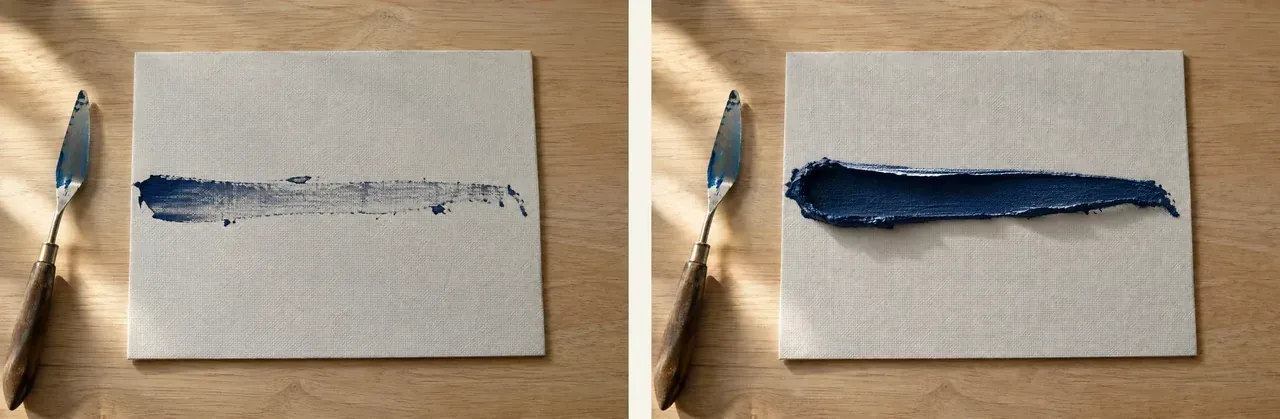
The same knife, the same color, the same board. What changed is the amount of paint picked up on the blade and the angle it was laid at, both of them settled before contact.
The digital book "Painting with a Knife: Holding the Blade, Loading It, Laying It Down", to read and to lay down tonight, with a scrap of cardboard beside you.
Keep reading if your painting knife went back into the drawer after two tries:
- No knowledge of knife painting is needed. This book assumes only that you already paint: that you have covered a few supports, that you know how to wait for a layer to dry, and how to crush two colors together on a palette. It also assumes acrylic in a tube and a support that does not bend, and it is written neither for watercolor on thin paper nor for oil.
- How the hand holds the tool, and which of the three holds leaves your wrist free. It is the first thing the books on the shelf assume is settled, and not one of them writes it down.
- Where the paint is picked up on the blade, and how much of it you pick up: three loads, and what each one leaves on the support once it is dry.
- The angle that lays down and the angle that scrapes, and why the support comes back through in patches as soon as you are a few degrees out.
- The thickness that casts a shadow of its own: what makes a mark still show three feet away, and the three thicknesses to get at will.
- The way the blade leaves the support, which is what makes the edge: cut on one side, dragged on the other, and decided before you start.
- What the blade cannot do, said plainly, and the exact moment the brush takes over again on the same support.
- The six-point check to run on a dry support, three feet away, before you say a support is finished.
Dear reader,
You already paint. You may have a painting knife in a drawer, bought one day because thick paint attracted you, and taken out twice.
The first mark scraped the support and left almost nothing. The second left a heap that spilled out on every side. You put the tool away, you went back to the brush, and you concluded that the knife was an imprecise tool.
This book is the tenth in the collection, and it is the only one that changes tool. The others teach you to decide what you lay and at what moment. This one teaches you to decide what the hand lays the paint with, and how.
From: Élise Marchand, for The Paint Method
Place: a kitchen table, somewhere in France
A knife mark is not drawn, it is laid down
What changed everything for me was not a better blade. It was giving up looking at the mark once it was there, and starting to look at what gets settled before the metal touches the support.
Because there are only four things to settle, and they are taken in this order. The load: how much paint, and where on the blade it is picked up. The press: the angle of the blade and the pressure of the hand. The relief: the thickness left behind, and so the shadow it casts. The lift: the way the blade leaves the support, which is what makes the edge.
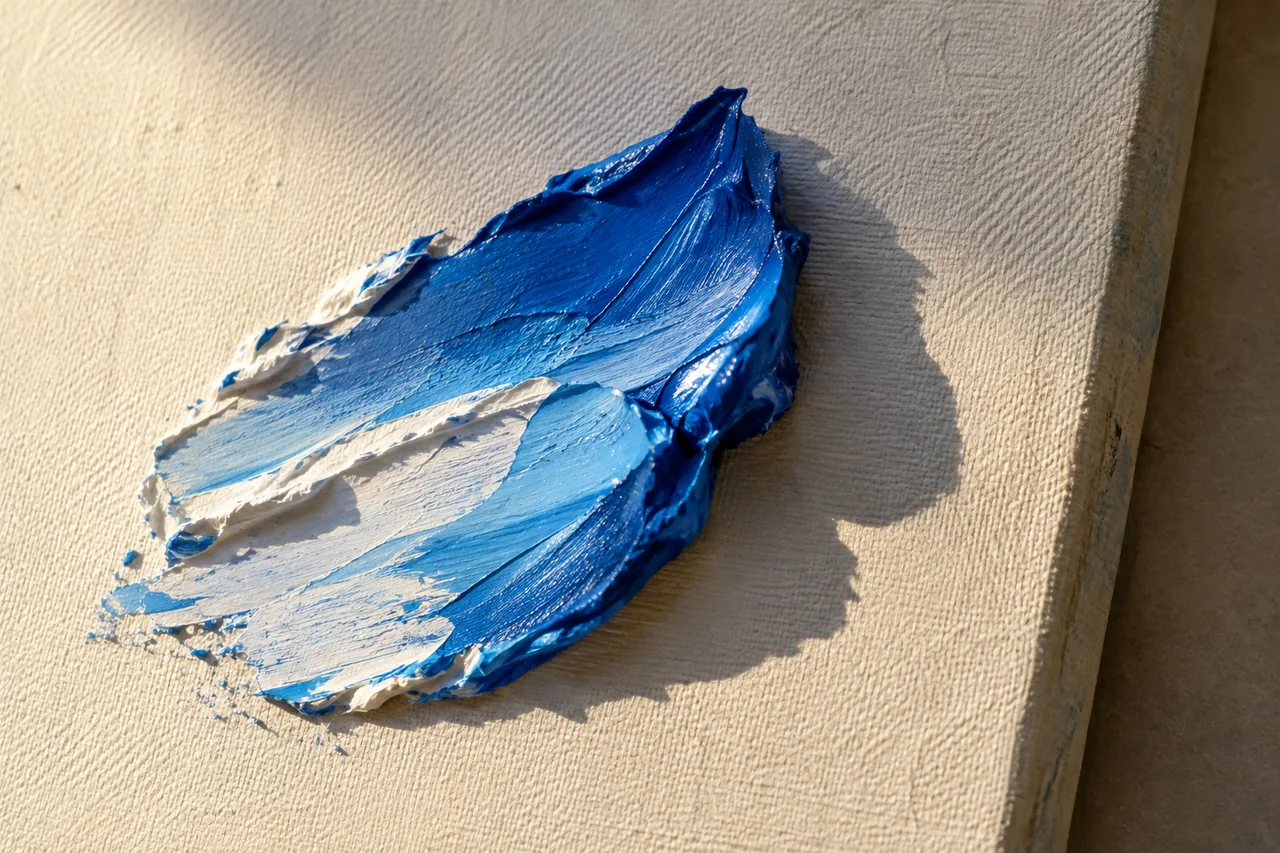
And here is what makes it usable: each stage closes the options of the next. A load that is too thin rules out any relief, whatever the press. A press that lies too flat spreads the load out and cancels the lift. And the lift is not caught up afterwards: it is the moment the blade leaves the support, and it happens once only.
That is the rule the whole book holds to: what is laid down keeps its shape, and that is exactly why you do not come back to flatten it. A blade passed again over a mark still soft crushes the relief and takes away the shadow it was casting.
Looking is free. You can lay three passes of the blade on three scraps of cardboard tonight and look at them from the side, before you decide anything at all on this page. But seeing the difference is not enough: you need the four stages, and you need to know which one was missing.
The four stages, in this order and in no other
The load. How much paint, and where on the blade it is picked up. Settled badly, the blade scratches the support and leaves almost nothing, or it leaves a heap that spills out on every side. It gets settled on a scrap of cardboard, in three tries, before you touch the support.
The press. The angle of the blade and the pressure of the hand, held without changing during the pass. Settled badly, the paint gets scraped instead of laid down, and the support comes back through in uneven patches along the pass.
The relief. The thickness left behind, and the shadow it casts by itself. Settled badly, the mark is flat, it casts no shadow of its own, and the whole support looks printed.
The lift. The way the blade leaves the support. Settled badly, the edge is dragged where it was meant to be cut, or the other way round. It is the only one of the four that happens once only.
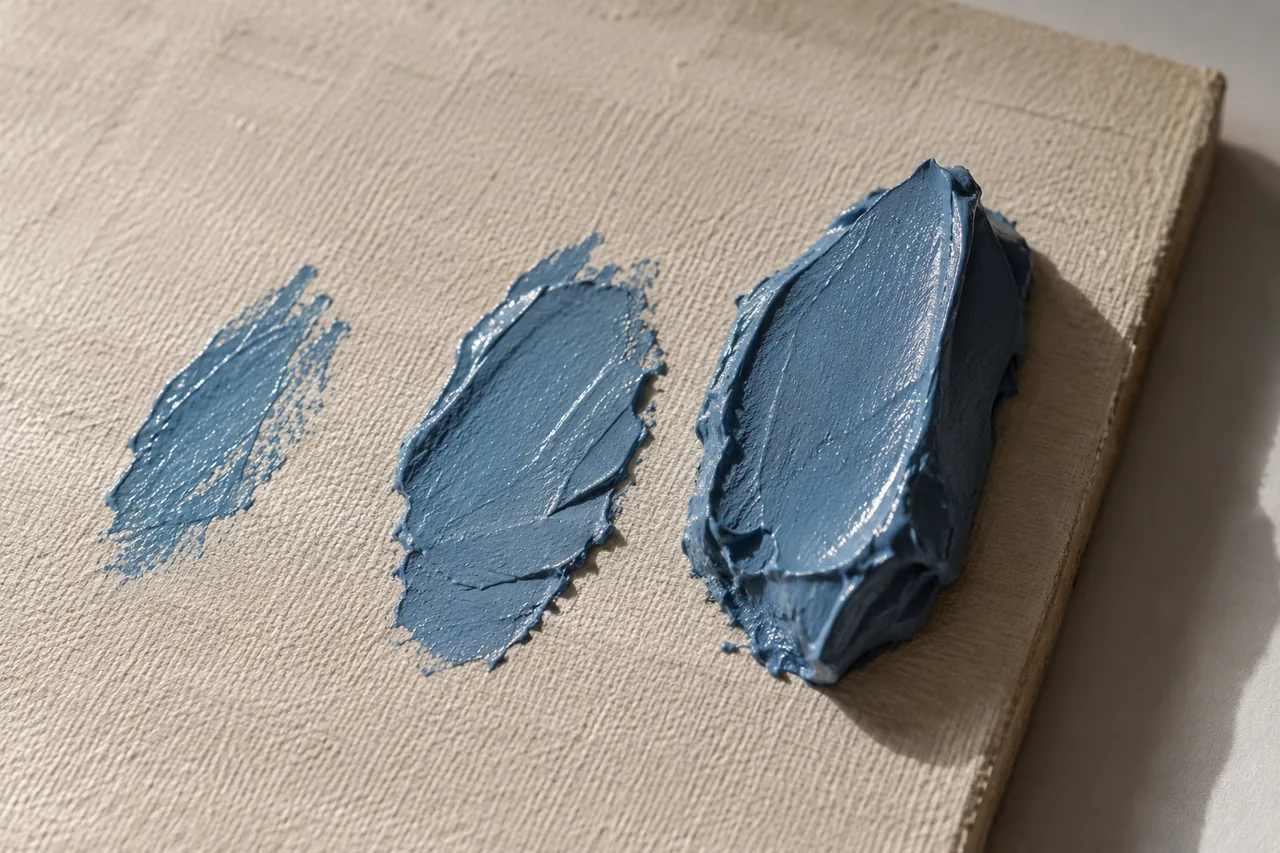
The order counts: you settle the load first because a load that is too thin rules out all the rest, and because correcting the angle serves no purpose as long as there is not enough paint on the blade.
At this point, you have two options
The second option asks for one read and one evening. The first costs you a tool asleep in a drawer, and a kind of paint the brush will never give you.
Imagine
- Imagine loading your blade and knowing, before you lay it, what the mark is going to leave, because you have just tried it on the scrap beside you.
- Imagine looking at one of your dry supports and being able to say, mark by mark, which of the four stages was missing. Not "it failed": that one is the press, and that one is the lift.
- Imagine laying two marks of different colors that touch along their whole length, and finding two colors you can still tell apart once they are dry.
- Imagine getting your knife out on a Sunday afternoon and painting a mass of foliage in fifteen marks, instead of spending the afternoon catching up.
What you will be able to do when you close it
- Hold the handle three ways and say which one leaves your wrist free.
- Load a blade three times running in the same place and get three comparable marks.
- Lay, from the same load, one mark that was laid down and one that was scraped, and show where the support comes back through on the second.
- Get three thicknesses at will and say which one you have just laid without touching it.
- Make a cut edge on one side of a mark and a dragged edge on the other, on that same mark.
- Say by touch whether a layer has taken its skin and is ready to take another one.
- Lay a mass of foliage, a field of dots, a stretch of water with its glints, and the ridge of a stone.
- Put one of your own dry supports through the six points of the check, three feet away, and name the one that was missing.
What you need to have, and what you must not buy
No lesson in this book makes you buy anything at all. That is a rule I set myself while writing it, because the most common advice, when a mark will not hold, is to buy better paint, a better knife, or a product to add to the paint. It is the advice that costs the most and settles the least.
The materials list asks you to buy nothing: the painting knife you own, and one is enough for the whole book; two tubes of acrylic, one light color and one dark, as long as they come out of the tube keeping their shape; a support that does not bend, a canvas, a canvas board or a panel; a rigid palette, or a flat plate; a rag and something to wet it with; and scraps of support cut out of packing cardboard.
The grain of those scraps has to be the grain of the support you paint on, or the trial teaches you nothing: a coarse-grained canvas eats part of the load, a smooth panel keeps it whole, and the same mark does not give the same thing on both. Five things from the house serve as well, and none of them is bought: a brush you already have, a desk lamp or a window for judging from the side, something to cut cardboard with, a pencil, and a book to prop a scrap at an angle.
That is all. No thickener, no product to add to the paint, no brand, no knife size laid down.
Which paint it is written for, and who it is for
This book is worked in acrylic, and it is the only one in the collection in that case. The medium, meaning the family of paint you work in, is not a detail here: a blade lays nothing down unless the paint stands up on it, and a color thinned with water on thin paper does not stand up. If you only paint in watercolor, you can read this book and the gesture will stay with you, but you will not be able to lay it down with what you have at hand. Oil is not dealt with either: the blade is handled there in the same way, but the paint stays open there for days, while acrylic takes a skin within moments, and every moment in this book is written for that skin. One thing thickness changes, and it is said here once: paint laid thick covers what is under it completely, and that is what is meant by its opacity.
This is for you if you already paint, regularly, and you want a kind of paint the brush does not give you. You have never held a knife? That is allowed for: everywhere a lesson has you look at an old support painted with a knife, the same move is given on a scrap for the reader who has none.
This is not for you if you are looking for paintings to copy out: the shelf is full of those, and this book gives instead the gesture those paintings assume you have. If you are looking for which colors to mix, or to judge a support on its values, meaning on its dark and its light: this book does not teach them, and other books in the collection make them their whole subject. If you are looking for a course on composition, meaning how a scene is cropped and arranged: that is not its subject, and the four subjects of the last part are separate, each painted for its own sake, never brought together into a landscape.
The questions you are asking yourself
"I only own one knife." One is enough for the whole book. The lessons are written for a single blade, and a wipe of the rag stands in for a second one. If you own several, one lesson will have you note down what each one gives on a form to fill in.
"My paint is too runny, that must be it." Perhaps, in part. But before you buy anything at all, do the three-second test from the first part: it is done on the blade, with nothing laid down, and it will tell you whether your paint stands up. The book deals with that case without making you buy a thickener or a product to add.
"My relief sinks after I lay it." That is a whole lesson, and the answer is an amount and a consistency, not a purchase. You will lay two marks of the same height on a scrap held at an angle, and you will see which one rounded off its edge.
"I have already tried, it will not work." You tried the four stages at once: more paint, another angle, another pressure, one more pass. When you change four things at a time, you do not know which one counted.
"I do not have the time." The four stages are given in full in Part 0, at the fourth lesson, and the first mark gets laid straight after. The rest you will open at the moment you need it, part by part.
"I am afraid of spoiling a canvas." You will not touch your canvas. Almost everything happens on scraps cut out of packing cardboard, and that is exactly what they are for: trying before laying.
"I am just not gifted." Nobody is born knowing at what angle a blade lays down instead of scraping. It is not talent, it is a piece of information. Nobody gave it to you, and you drew a conclusion about yourself out of a silence.
"And if I need help?" You write to contact@thepaintmethod.com. A real address, on this page, before you buy.
I am pleased to introduce my digital book:
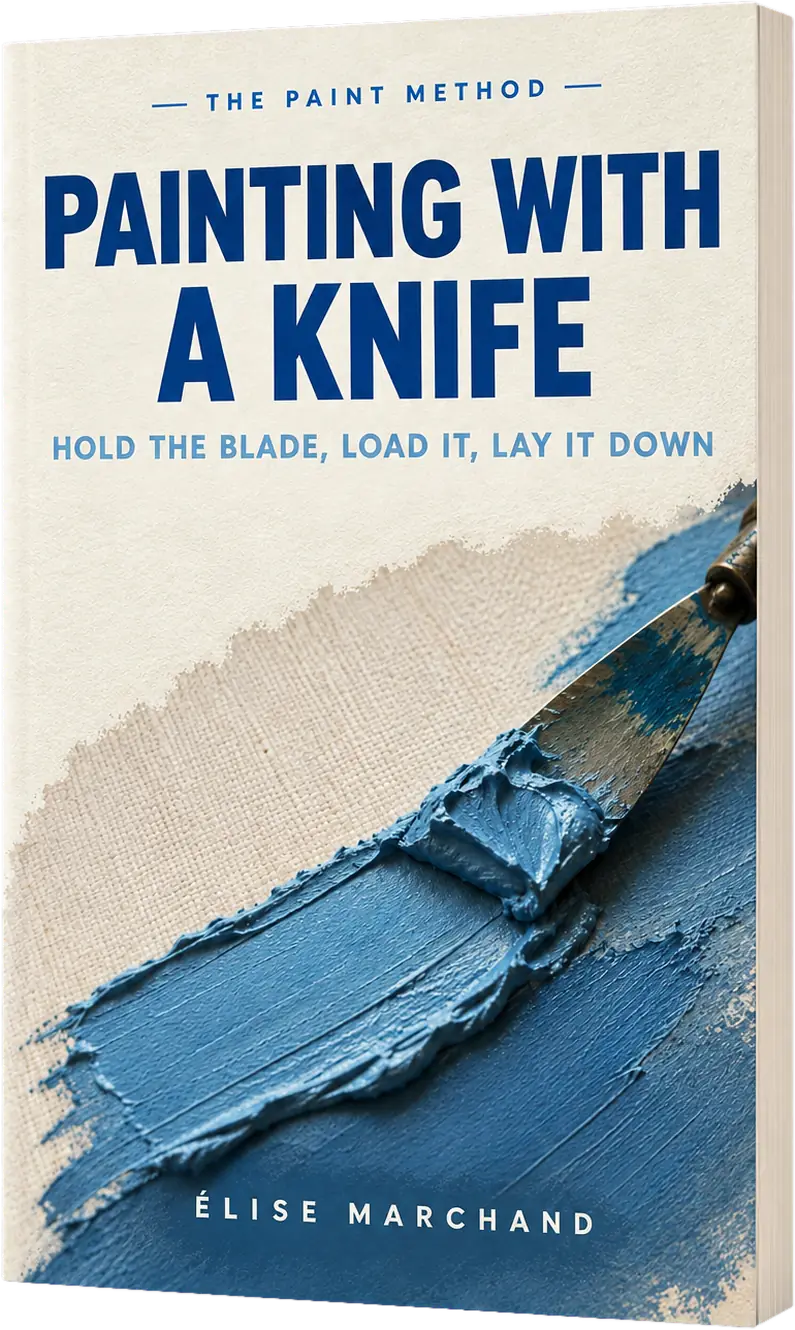
"Painting with a Knife: Holding the Blade, Loading It, Laying It Down"
A digital book in PDF, to read on your phone beside the support, on your computer, or printed if you prefer paper.
It is built around a constraint I set myself: the marks are photographed under a raking light, so that the thickness and the cast shadow show on the page as they show on your table. You have to be able to compare what you get with what is printed, without having to describe it in words you do not have. There are sixty-two plates.
Every lesson ends with a line that begins "By the end of this lesson, you can", and names something you do, not something you understand. That is what can be checked.
It is written in plain language, with no expert vocabulary. You need nothing but your knife, two tubes and a scrap of cardboard.
What is inside, part by part
Four lessons. We do not open on a blank support: we open on the mark you did not get, the one that scraped or the one that spilled over. What acrylic does that is particular under a blade, what to put out on the table, and the four stages given in full at the fourth lesson.
Six lessons. How the hand holds the handle, where the paint is picked up on the blade, how much of it you pick up, what to do with paint that is too runny, the mix crushed on the palette with the blade, and the wipe of the rag between two loads.
Six lessons. The angle that lays down and the angle that scrapes. The pressure, and what it settles. The flat, the tip and the edge, named separately. The direction and the length of the pass, what your support takes, and laying onto a layer already there without carrying it off.
Six lessons. The thickness that casts a real shadow, the three thicknesses, relief that sinks, the two places on a support that take the full thickness, and what drying takes away from it. It is here, and once only, that the book says what glazing does not do: transparent layers built one over another alter the color, they make no cast shadow at all.
Five lessons. The cut edge and the dragged edge, two marks that touch without running together, the mark that stops partway, and the count of clean edges on one support.
Five lessons. The small and the fine, the large smooth area, going gradually from one color to another. It is here, and once only, that the book names the wash, that thin and even layer a blade cannot lay, and says at what moment the brush takes over again on the same support.
Five lessons. Four subjects taken step by step: a mass of trees, a field of flowers seen from far off, water with its glints, and a stone. Each one painted for its own sake, in a few marks. Then the six points of the check, run on a dry support, three feet away.
The card of the three ways in, the card of the four stages, the card of your knives and your supports, the strip of the three thicknesses, and the six-point check card. All of them blank: a form already filled in is a recipe, and a recipe never works twice. If you cannot print them, they can be copied out by hand: all they ask for is lines, boxes and empty frames.
You don't need to buy another knife to check.
The one you already own, on an offcut of canvas board, is enough.
Tonight you will know how to hold it, how much to load it and at what angle to lay it so a mark keeps its ridge and its clean edges instead of flattening out.
A knife mark is judged once dry, on its edges. That is where everything is decided.
And you?
Which mark will you lay down first?
Your digital book, today
- The complete book in PDF: 37 lessons, 7 parts, 62 color plates (value: $47)
- The five printable forms, including the card of your knives and your supports, to fill in with the equipment you already own
- The six-point check, run on a dry support, three feet away
- Lifetime access, to read and reread at your own pace, on whatever you like
Value: $47 → today:
The usual price of this book is $47. Today, it is $17.
100% digital access, immediate. Nothing is shipped.
You get your lifetime access by email, within a minute of your order.
30-day guarantee, no conditions
Read the book. Lay three marks on a scrap of cardboard tonight, and look at them from the side once they are dry. Do the four subjects of the last part. If within 30 days you feel it brings you nothing, write to contact@thepaintmethod.com and you are refunded in full.
No form, no justification, no questions. And you keep the book: I would not know how to take it back anyway.
In other words: either your knife finally comes out of the drawer, or this book costs you nothing. The only risk left is closing this page and leaving the tool where it is.
P.S. If you remember one thing from this page, remember this: a knife mark is decided in four stages, the load, the press, the relief and the lift, and all four get settled before the metal touches the support. As long as you do not know which one was missing, you correct at random, and the pass too many crushes what was left.
P.P.S. The book is worked in acrylic, on a support that does not bend. It is $17 today instead of $47, and it is covered by the 30-day guarantee. You can read it tonight, lay three marks on a scrap of cardboard, and decide afterwards.