How to decide what your photo will give on the sheet, before the first color, with the pictures you already have in your phone.
Because a painting that fails is settled four decisions earlier than you think: the moment you choose the photo, the moment you decide where the edge of the sheet falls, the moment you write down what you keep, and the moment you look at what the camera threw away. No prior knowledge is needed: what you do need is photos of your own, and you have hundreds of them.
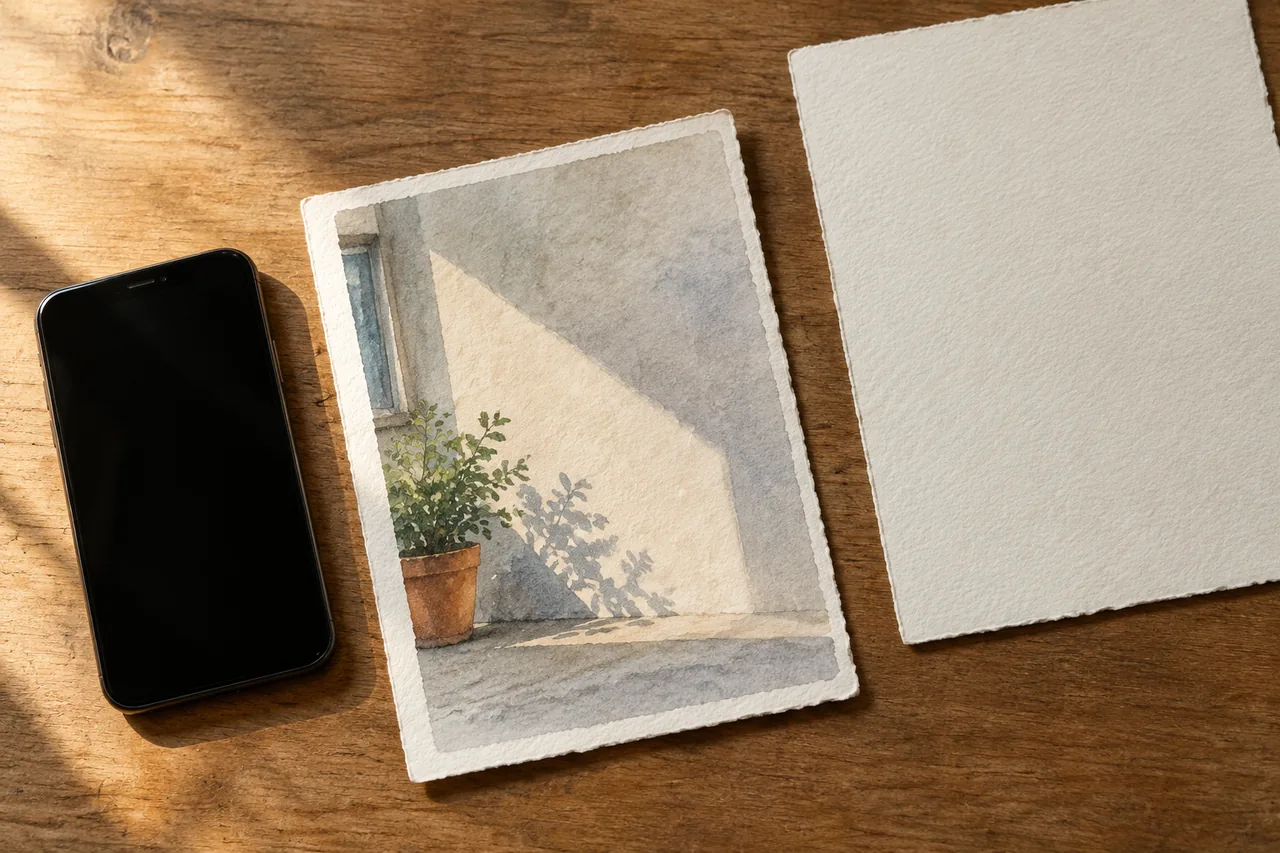
The digital book "Painting from Your Own Photo", to read and apply tonight, with your picture in front of you, printed out or simply left on the screen.
Keep reading if you have hundreds of photos and not one painting that looks like them:
- Why the photo you chose already decides half the painting, and the three questions that sort ten of your photos.
- Where the edge of your sheet falls on the photo: the three crops that work, and the one that never does.
- The three things at most your painting will show, written down before you begin, and what you do with all the rest.
- The three lies of your photo: the blocked shadow, the blown-out white, the leaning line. What the camera threw away, and what you put in its place.
- How to place your photo on the sheet, enlarge it and trace it in pencil, with no instrument and nothing to buy.
Dear reader,
You have a watercolor box, and above all you have a phone full of photos. A holiday, a street in the sun, an animal on the grass, a table by a window. You look at them telling yourself there is a painting in there, and you cannot say which one.
And if you have tried, you know what I am talking about. You take the photo you like best, you put it on the sheet, you paint everything in it. In the end the painting is faithful to the photo, and it is as dark and as dull as the photo is. You do another one the following Sunday, with another photo, and it starts again.
From: Élise Marchand, for The Paint Method
Place: a kitchen table, somewhere in France
What you are missing is not a model, it is a decision
What changed everything for me was not painting better. It was giving up on opening a blank sheet, and starting instead by opening my photos.
Because in front of a print there are four questions, and all four are asked before the first color. Which of my photos gets painted. Where the edge of my sheet falls on that one. What I keep, and what I take out. And what my camera threw away without telling me.
And here is what makes it usable: the four answers get written down. They fit on one page, the reading sheet, and until it is filled in no color gets laid. It is not a discipline, it is what saves you from finding out on the third layer that you were painting a photo with no subject.
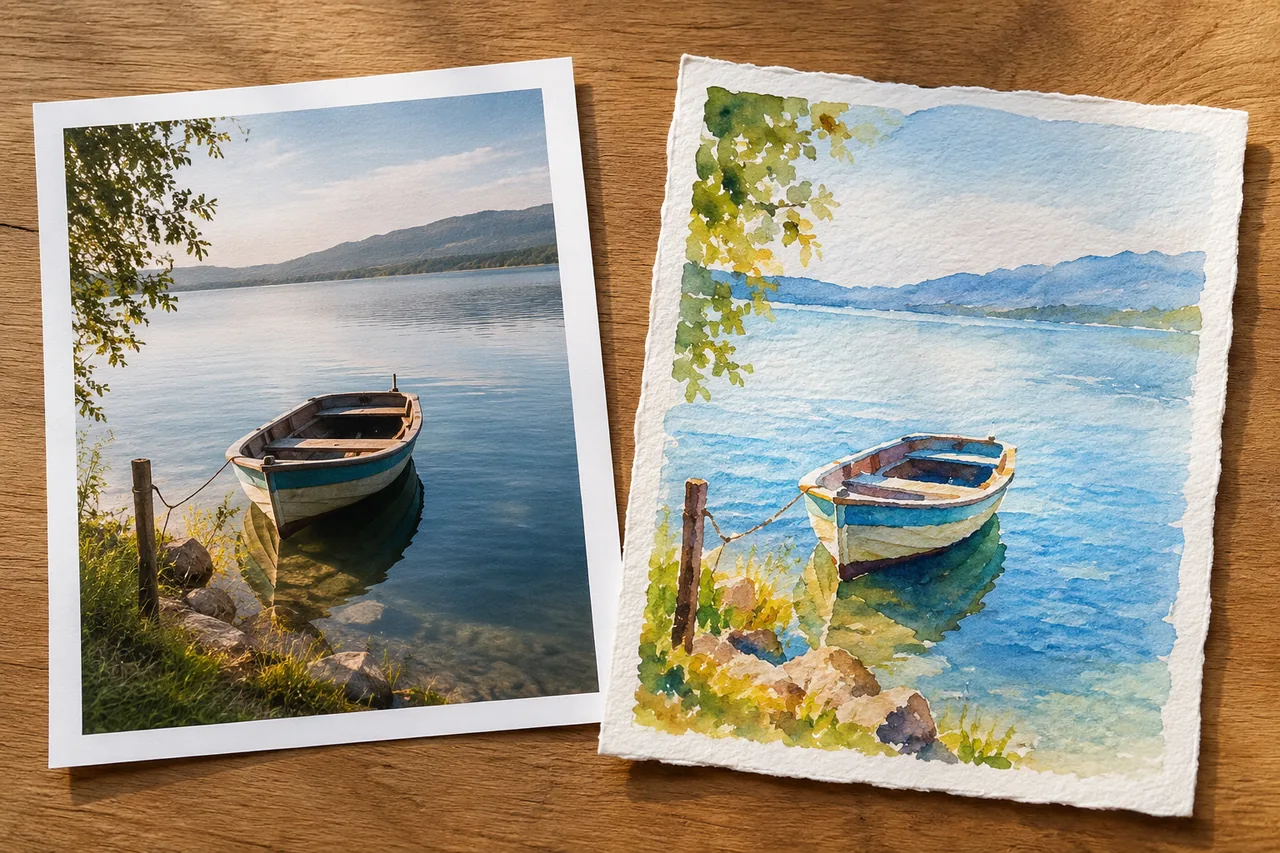
That is the rule that holds the whole book: you read the photo before you paint it, and reading means writing. A painting that disappoints is almost never a problem of the hand: it is a photo nobody sorted, an edge nobody decided, a list nobody wrote.
That reading costs nothing. It takes ten minutes. You can do it tonight on ten of your own photos, before deciding anything at all on this page. But answering one of the four questions is not enough: you need all four, and you need to know in which order to take them.
The four passes, in this order and no other
The sort. Which of your photos gets painted, and which does not. Three questions: is there one single thing in it, does the light come from one side, could you say in one word why you took it. Three yeses, you keep it; two yeses, you set it aside; one yes, you drop it, and you do not hold it against yourself.
The crop. The edge of your sheet is not the edge of your photo: a camera chose that rectangle for you, on the spot, and usually too wide. You take it back, you mark a smaller rectangle on the print, and it is the crop that gives the format of the sheet, never the other way around.
The short list. Three things at most, written down: the one thing, what carries it, what places it. Anything not written down is background, and the background keeps quiet. The parked car, the sign, the power line, the blurred passerby: you take them out, and you write what takes their place.
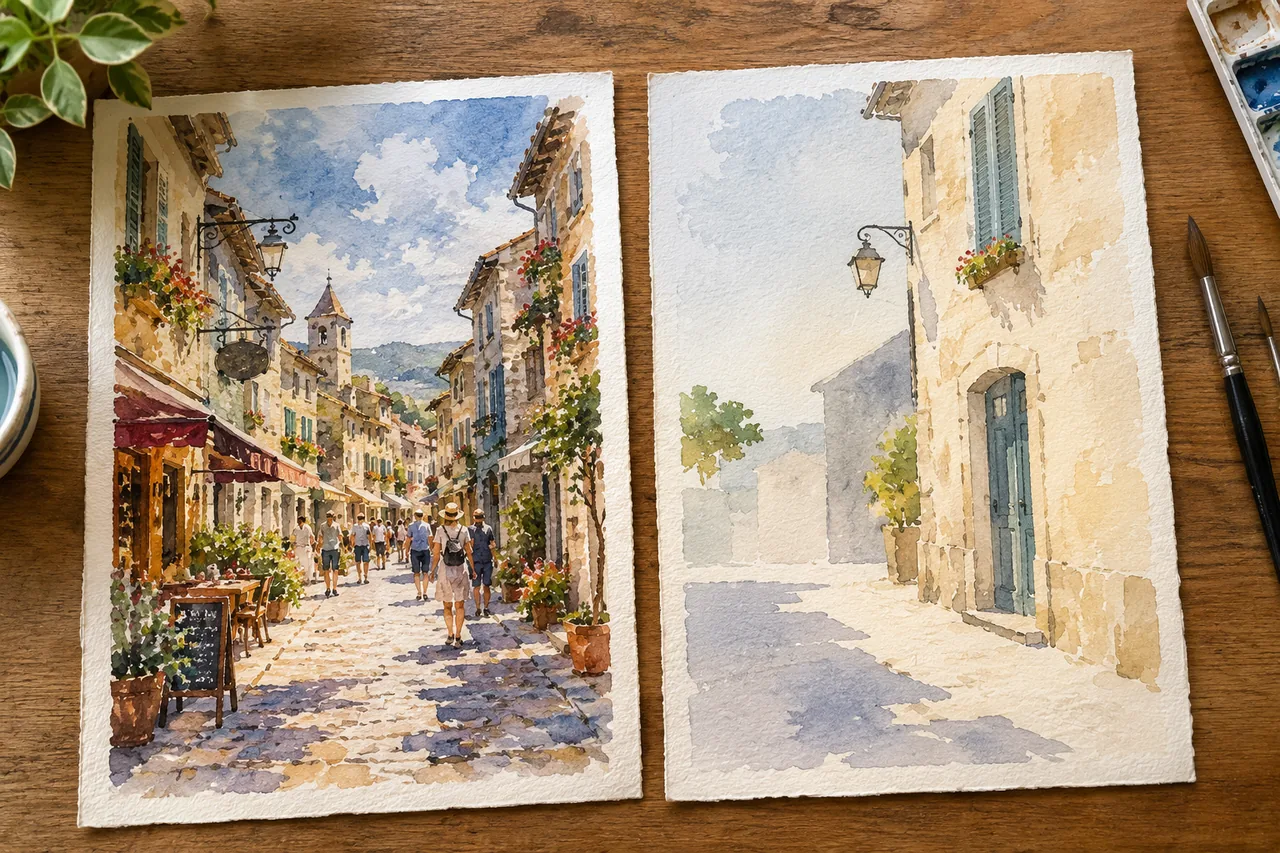
The three lies. What your camera threw away: the blocked shadow, where there is nothing left to read; the blown-out white, where the sky has nothing left in it; the leaning line, when the lens made your verticals run away. You find them on your own print, and you decide what goes in their place.
The order matters: you sort first because none of the three passes that follow can rescue a badly chosen photo, and because a beautiful crop on a photo with no subject is still a photo with no subject.
At this point, you have two options
The second option asks for one read and one evening. The first costs paintings you no longer dare show, and a box you end up putting away.
Imagine
- Imagine opening your phone and pointing, in five minutes, to the one photo out of ten that gets painted today, and being able to say why the other nine are waiting.
- Imagine laying a rectangle on your print and knowing, before you draw anything at all, which paper format you need.
- Imagine writing three lines and crossing out the rest, instead of copying a whole photo, corner by corner.
- Imagine looking at a black shadow on your print and knowing exactly what you are going to put in it, because you decided beforehand and not because you improvised with the brush in your hand.
What you will be able to do when you close it
- Sort ten of your photos into three piles and keep only one, answering the three questions in writing.
- Mark on a print of your own a rectangle smaller than the photo, say what falls outside it, and work out from that the format of your sheet.
- Mark with a cross the place that counts, and check that it does not land in the exact center.
- Write the three things your painting will show, cross out three things on the print and say what will take their place.
- Point to a blocked shadow and a blown-out white on your print, and say what ought to be there.
- Lay a ruler on your print, see whether your verticals lean, and decide which ones you straighten.
- Place your photo on the sheet in pencil, enlarge it to the right format, and stop before any detail.
- Run your reading sheet through the six-point check and say which point stops you.
What you need to have, and what you must not buy
You need nothing more than what you already own. That is a rule I set myself while writing this book, because the most common advice, when a painting made from a photo disappoints, is to buy a transfer product, an app or a camera. That is the advice that costs the most and settles the least.
The materials list asks you to buy nothing: your photos, exactly as they are in your phone; an ordinary pencil and something to rub out with; your paper; a ruler; and a cardboard box you will cut two Ls from. The grain of your paper is the one you have, and nothing in this book asks you to change it: what is decided here is decided before the water touches the sheet.
A paper print helps, it is not compulsory, and at every exercise the book says what to do if you have no printer. No color to buy, no app to install, no accessory.
For which materials, and for whom
The book is written for watercolor, and the four passes hold for gouache and for diluted acrylic as well: those are three water-based mediums, and a photo is read the same way for all three. What changes from one to the next is what covers and what lets the paper through, that is, opacity, and here it counts in one place only, where you decide which whites you keep. It is not written for oil paint.
This is for you if you are starting out, or coming back to it after years away. No prior knowledge is needed: nothing to revise, no school word to know in advance. You already have photos of your own, and you want to know which one to paint and what to keep of it.
What this book is not. It does not build a color: another book in the collection does that. It does not teach you to judge whether a painting is dull or flat, nor to work on what are called values: another book in the collection teaches those, under that name, and promising it here would be selling you the same lesson twice. It does not tell you when to put the brush down. And it does not paint for you: it stops at the first color, and it says so from the third lesson on.
The questions you are asking yourself
"My photos are phone photos, they are worth nothing." Those are exactly the ones this book works on. Not one lesson asks for a camera, a lens or a setting. The three full readings at the end are done on ordinary photos, taken freehand.
"I do not have a printer." A paper print helps, it is not compulsory. Marking a rectangle, laying a ruler along a vertical: the moves that need paper are done against the screen, and the workbook says so where it matters. One exercise really needs both, the one that compares the same photo on the screen and on paper, and it is written plainly instead of pretending otherwise.
"I cannot draw." The placing is done in pencil, without construction: you lay four or five big shapes, very lightly, and you stop. Enlarging and tracing are moves of placing, not moves of drawing, and the book gives you both.
"I have tried everything already, it will not work." You have tried everything at the same time: another photo, another paper, more time, a different placing. When you change four things at once, you cannot tell which one counted. This book does not offer you a fifth thing to change, it offers you to decide the four in order.
"I do not have the time." The four passes are read in a quarter of an hour and laid down in ten minutes on a photo you already have. The rest you will open when you need it, one pass at a time.
"I am afraid of spoiling a good sheet." Everything this book decides is decided before the water touches the paper. You are risking nothing: the reading sheet is filled in beside you, and that is exactly what it is for.
"I am just not gifted, that is all." Nobody is born knowing that a camera throws away the detail of the darkest darks and the lightest lights. That is not talent, it is information. Nobody gave it to you, and you drew a conclusion about yourself out of a silence.
"And if I need help?" You write to contact@thepaintmethod.com. A real address, on this page, before you buy.
I am pleased to introduce my digital book:
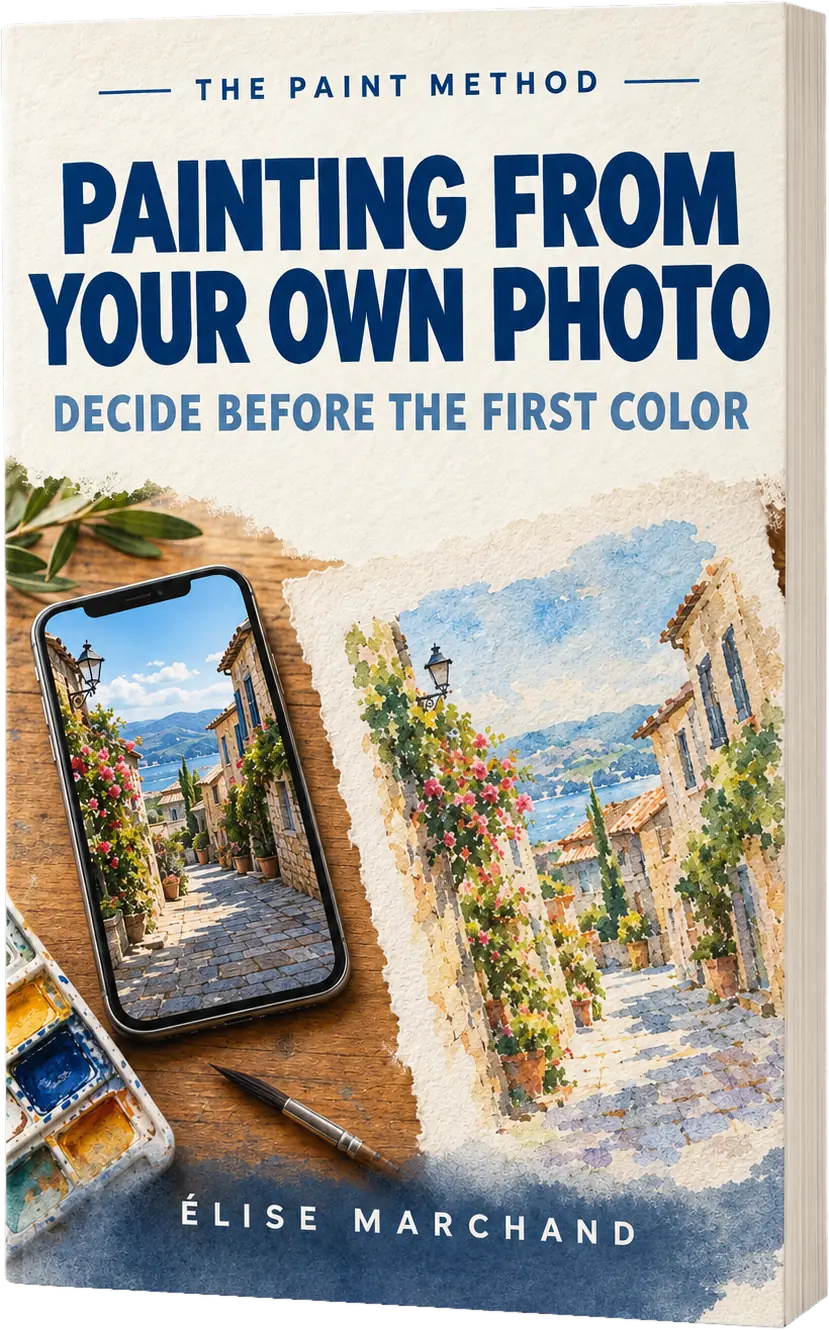
"Painting from Your Own Photo"
A digital book in PDF, to read on your phone beside the sheet, on your computer, or printed if you prefer paper.
It is the only book in the collection that starts from the photo you already have, instead of from a blank sheet.
It is built around a constraint I set myself: you see both sides. Every time a decision is taken, the plate shows the print and what came out of it, side by side, full width. There are sixty-two of them.
Every lesson ends with a line that begins "By the end of this lesson, you can", and names something you do, not something you understand. That is what can be checked.
It is written in plain language, with no expert vocabulary. You need nothing but your photos, a pencil and your paper.
What is inside, part by part
Three lessons. You do not open on a blank sheet: you open on ten of your own photos, pulled out in five minutes. The four passes are done once all the way through, on one single photo, without laying a single color.
Five lessons. The three questions of the sort. The photo with one thing in it. Light that comes from one side. The five photos that will not be painted, including the full backlight and the photo that goes soft when you enlarge it. And what to do when you have shot the same place six times.
Five lessons. This is the part that deals with what the market calls composition, and it deals with it in moves: three crops that work, the one that never does, the format of the sheet that comes out of the crop, the place that counts marked with a cross, and the same move made on the phone or with two cardboard Ls.
Five lessons. Three things, no more. What you take out and what takes its place. Moving, bringing forward, enlarging, and the one limit. The background cut down to two or three big areas. And a reading sheet filled in all the way, line by line.
Six lessons. The blocked shadow, the blown-out white, the leaning line, and the trap of the screen, which is not a fourth one. This is also where the white of the sheet is decided, the one that does not come back. All of it is settled before the first wash and long before any glaze: nothing has been laid on the paper yet.
Five lessons. Four or five big shapes and nothing else. Placing with a grid, to enlarge without an instrument. Tracing, and when it is honest. What the placing does not give you. And where to put the print on the table so that you do not turn your head.
Six lessons. The reading sheet in full and the six-point check, two of them blocking. Then three readings carried step by step from the print to the finished painting: a building in the sun, an animal on the grass, a table by a window. We close on the case where the right decision is to pick the camera back up.
The reading sheet, the two cropping Ls to cut out, the three lies sheet, the placing grid, and the six-point check sheet. Plus one example already filled in, with the line left empty and what that empty box triggers.
You don't need a better photograph to check.
The ones already on your phone are enough.
Tonight you can open one and decide, before the first color, what it will keep, what it will simplify, and what it will drop.
The paper does not copy the photograph. It carries out a decision you made before wetting it.
And you?
Which photograph will you decide on first?
Your digital book, today
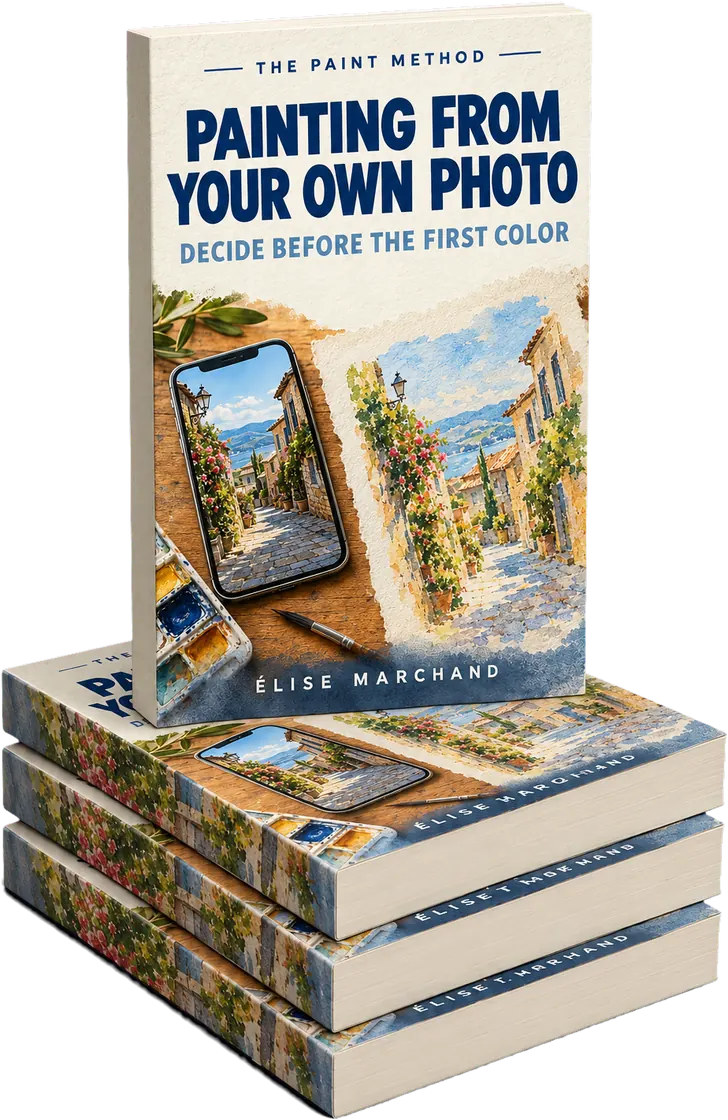
- The complete book in PDF: 35 lessons, 7 parts, 62 color plates (value: $47)
- The five printable forms, including the reading sheet that carries the four passes on a single page
- The six-point check, to run before the first color
- Lifetime access, to read and reread at your own pace, on whatever you like
Value: $47 → today:
The usual price of this book is $47. Today, it is $17.
100% digital access, immediate. Nothing is shipped.
You get your lifetime access by email, within a minute of your order.
30-day guarantee, no conditions
Read the book. Pull out ten of your photos tonight and do the sort. Fill in one reading sheet all the way. If within 30 days you feel it brings you nothing, write to contact@thepaintmethod.com and you are refunded in full.
No form, no justification, no questions. And you keep the book: I would not know how to take it back anyway.
In other words: either you finally know what to paint in your photos, or this book costs you nothing. The only risk left is closing this page and copying one more photo from end to end.
P.S. If you remember one thing from this page, remember this: you already have the photo. What you are missing is not a model, it is a decision, and there are four of them. Which one I take, where I cut, what I keep, and what my camera threw away. Until those four lines are written down, you paint at random, and the painting looks like the photo without being worth the trouble.
P.P.S. The book is $17 today instead of $47, and it is covered by the 30-day guarantee. You can read it tonight, pull out ten of your photos and fill in your first sheet before you have even touched your box.