How to make your landscape go back by sorting it into three planes, before the first color, with the box and the paper you already own.
Because a landscape that sits on one single layer is neither a lack of talent nor a lack of equipment: it was never sorted. An image gets sorted into three bands of distance, the far distance, the middle and the front. Each one is given three settings decided before the brush is loaded: its lightness, its sharpness and its join. And the three get laid from the furthest to the nearest.
You need no knowledge of perspective and none of landscape: nothing to revise, no school word to know in advance. You do need to know how to load a brush, lay a color on paper that takes water, and wait for a layer to dry, because this book starts exactly there.
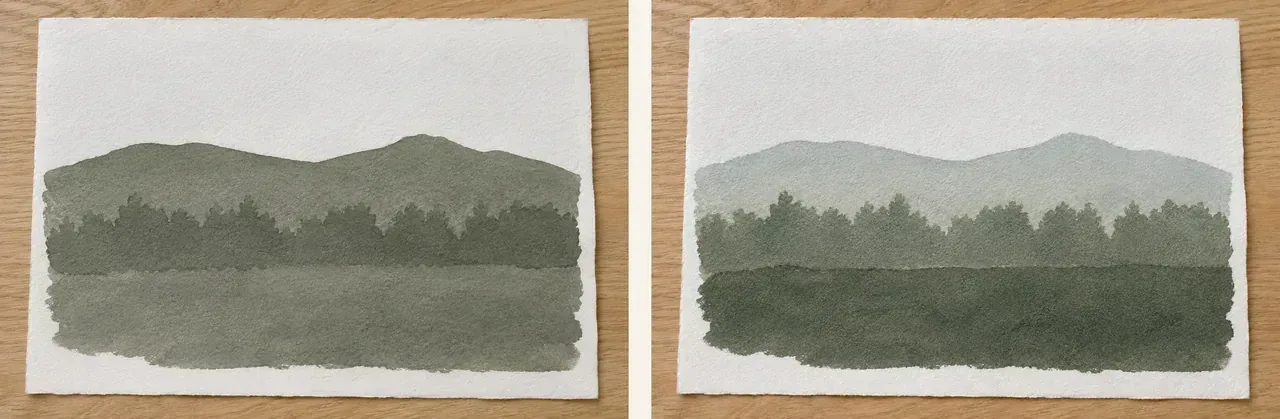
The same image, the same paper, the same brush. What changed is three settings written down before the brush was loaded.
The digital book "Painting a Landscape in Three Planes", to read and apply tonight, with one of your dry landscapes beside you.
Keep reading if your landscapes flatten out, if everything in them seems to sit at the same distance:
- Why your landscape was sorted, or was not sorted, before the first color, and why you are always sent back to correct on the sheet, where there is nothing left to correct.
- The three planes of an image, the far distance, the middle and the front, and what each one is allowed to carry: three bands of distance, not three layers and not three steps.
- The three settings that come back three times, one per plane: its lightness, its sharpness, its join. Three questions asked three times, and not three recipes to remember.
- Why one single sharp branch in the far distance brings the whole band forward, and what takes the place of detail when a plane is not entitled to it.
- The order of laying, from the furthest to the nearest, and the three things a plane already laid forbids the next one.
- The check from three feet away, on the dry sheet: what you look at, in what order, and what you no longer touch.
Dear reader,
You have a box of watercolors and a landscape picture you have liked for a long time. A hill, a track, a stretch of coast. It may have been sitting on your phone for months.
And if you have tried it, you know how it goes. You start with whatever draws you in, the tree, the house, the subject. You paint every piece with the same care. You step back, the sheet dries, and everything in it is at the same distance: the background climbs onto the front, the front goes back, and nothing stands behind anything. You put the sheet away in a drawer.
From: Élise Marchand, for The Paint Method
Place: a kitchen table, somewhere in France
A landscape does not get painted from left to right, it gets sorted first
What changed everything for me was not better paper. It was giving up painting a landscape piece by piece, and starting by sorting it.
A landscape image gets sorted into three bands of distance, and there are only three. The far distance, what touches the horizon. The middle, between the two, which almost always carries the subject. The front, at the bottom of the sheet, the one that gets laid last. These are neither three layers of paint nor three steps of a method: they are three distances.
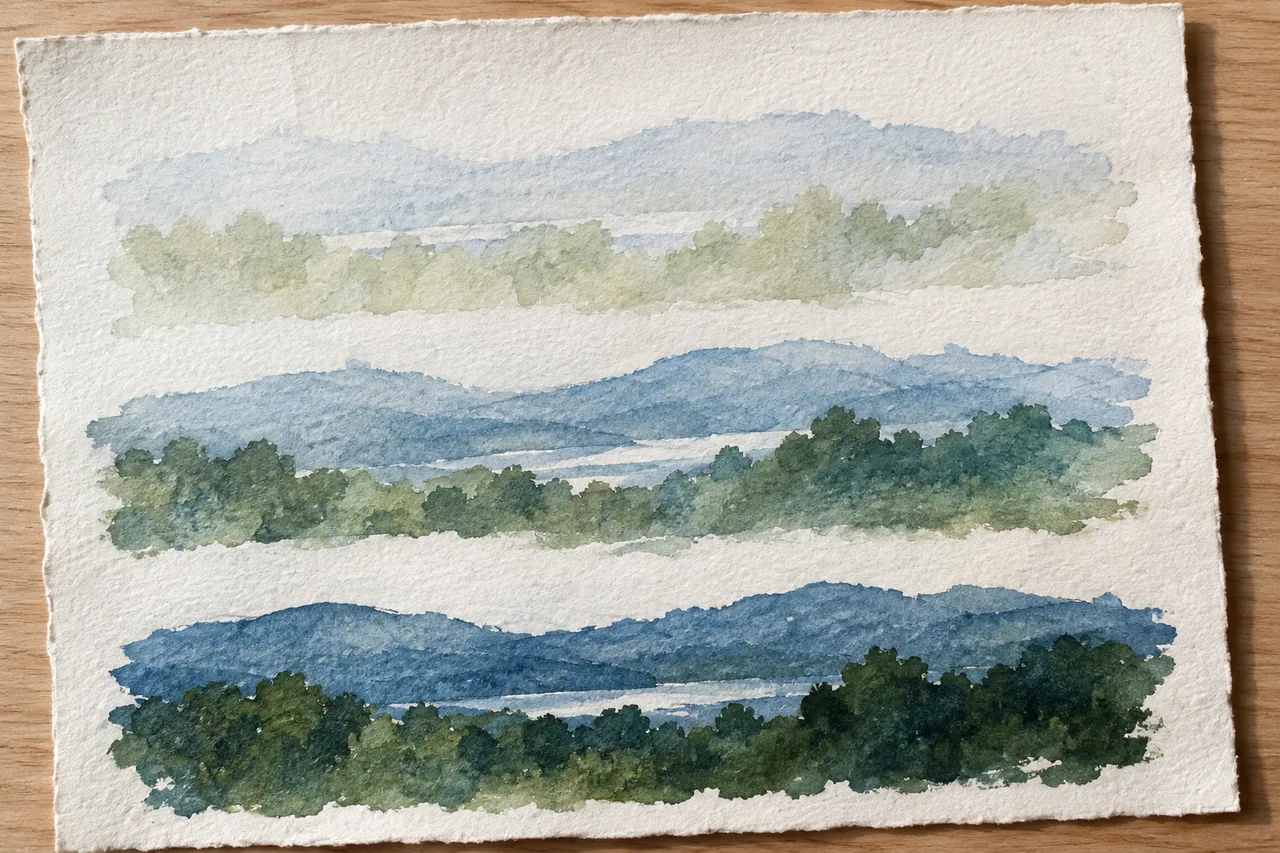
And here is what makes it usable: each plane is given the same three settings, decided before the brush is loaded. Its lightness, that is, how pale it is against the other two. Its sharpness, that is, the amount of detail it is allowed to carry. Its join, that is, the way it stops against the next one. Three questions, asked three times.
That sorting is free. It takes ten minutes and it asks for no painting: two light pencil lines in the margin of an image you already have, and you know where your three planes fall. But sorting is not enough: they then have to be laid, and the order in which they go in decides everything else.
The three planes, and the three settings that come back for each one
The far distance. The band that touches the horizon, the lightest on the sheet, and the one you lay first. It is entitled to no sharp edge: one single sharp branch in it, and the whole band comes and sits in front of you. What takes the place of detail is an overall shape and one single difference of lightness inside the band.
The middle. This is the band you look at, so it is the one you put too much into. It carries the subject, it stands clearly denser than the far distance, and its shapes are recognized from far off without a single leaf or a single tile being painted in them. Its gap in lightness with the far distance gets decided beforehand, on a scrap of paper, and it gets judged dry.
The front. The nearest band, the densest, and the only one entitled to be sharp. The one sharp edge of the sheet is here, and there is only one. It is also here that the grain of the paper disappears completely under the color.
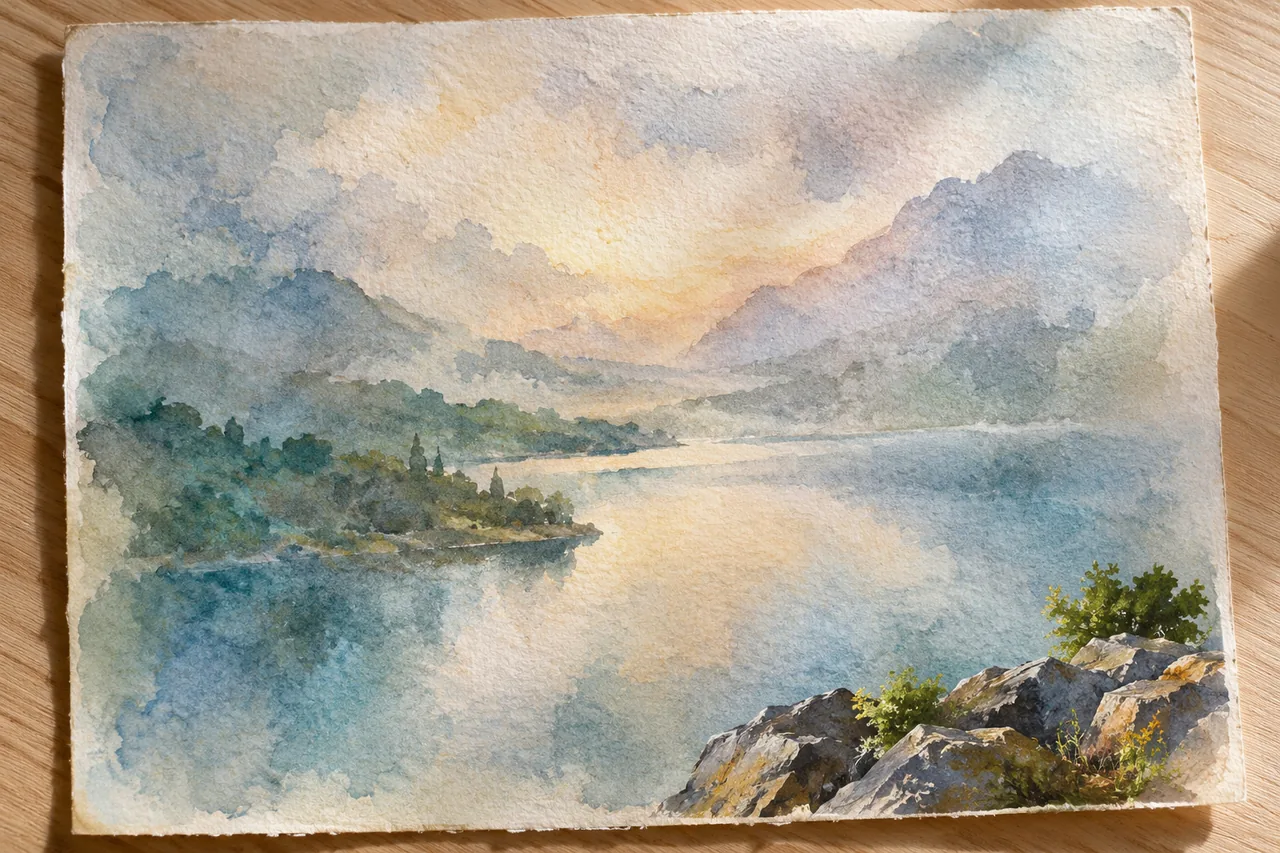
The order counts, and it is not a habit: in watercolor, whatever is laid in front can no longer be gone around. You lay from the furthest to the nearest, and each plane already dry forbids three things to the next one.
At this point, you have two options
The second option asks for one read and one evening. The first costs landscapes you no longer dare show, and an image you still have not painted.
Imagine
- Imagine looking at an image and knowing, before you open the box, where its two lines fall and which of the three planes carries your subject.
- Imagine laying three bands on a scrap of paper and seeing, once they are dry, whether your sheet will hold, before you have touched the good sheet.
- Imagine looking at one of your old landscapes and being able to say which of the three planes comes forward, and which of the three settings caused it.
- Imagine laying a far distance, stopping, and knowing by the three signs that the middle can go in.
- Imagine getting your box out on a Sunday afternoon and painting that image at last, instead of looking at it again.
What you will be able to do when you close it
- Point out, on one of your dry landscapes, the two places that are at two different distances and that carry the same lightness.
- Draw in the margin of an image you already have the two lines that separate your three planes, and say which of the three carries your subject.
- Lay three bands on a scrap of paper, judge them dry, and say whether the three can be told apart from three feet away.
- Lay a far distance that carries no sharp edge, and show it on the dry sheet.
- Lay in your front a mark dense enough that the grain of the paper no longer shows in it, and leave only one sharp edge there.
- Let a join fade out in at least one place, so that it does not cut the sheet in two.
- Fill in, before loading the brush, the order of laying list in six lines, with its two waits marked.
- Name, in front of one of your dry sheets, the plane that comes forward and say whether it is too dense, too sharp or too bordered.
- Run the check in six points from three feet away, and name the one that was missing.
What you need to have, and what you must not buy
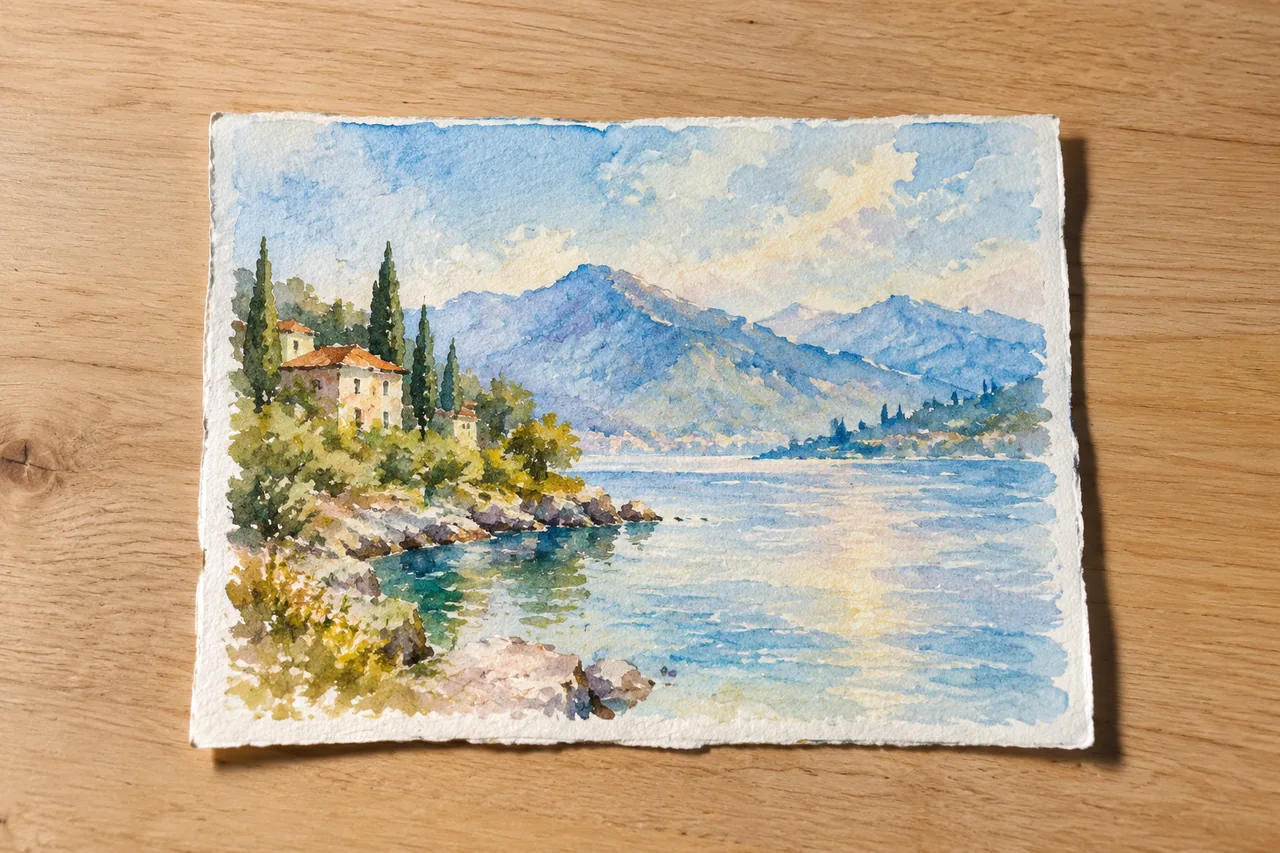
You need nothing more than what you already own. That is a rule I set myself while writing this book, because the most common advice, when a landscape flattens out, is to buy better paper or one more color. It is the advice that costs the most and settles the least.
The materials list asks you to buy nothing: a brush that holds a point and keeps water in it; a smaller brush; the box you own, exactly as it is; paper that takes water; a glass; a rag; and a scrap cut from the same paper as the one you will paint on.
The grain of that scrap has to be the grain of your sheet, because it is the grain that decides what shows through a very pale far distance and what has to be loaded to fill it in a very dense front. On other paper, the trial teaches you nothing about what will happen on yours.
That is all. No paper to buy, no color to buy, no brush to buy.
Which paint it is written for, who it is for, and what this book is not
The book is written for watercolor, and the three planes hold in the same way for gouache and for diluted acrylic: those are three water-based mediums, and a distance gets sorted in the same places in all of them. What changes from one to the next is how far the color covers, in other words its opacity: a covering color does not let the grain of the paper show through a pale far distance, and the book says so every time it counts. It is not written for oil paint, where the order of laying it speaks of does not carry the same consequence.
This is for you if you have already painted a few sheets, if you know how to load a brush and lay a color, and if your landscapes do not go back. You have an image in front of you and you do not know which end to take it by. You want to understand what is happening, not follow steps to copy out.
This is not for you if you are looking for ready-made landscapes to reproduce: this book gives none, it gives an order of laying. Or if you have been painting for fifteen years and your three planes already count.
What this book is not. It is not a course on values: it does not teach them under that name and it does not measure your painting once it is finished, and another book in the collection does that work plainly. It is not a course on composition: where to put the horizon, what you keep of the scene and where you crop are not its subject; it receives an image already cropped and it sorts it. It builds no color, it traces no dirtied color back to its cause, and it teaches neither the flower nor what a sky and a stretch of water ask of their first layer. Each of those pieces of work is named in the book, in one sentence, and sent on to the book in the collection that deals with it.
The questions you are asking yourself
"I have never understood how you make a background go back." That is exactly the subject, and the answer is not a knack. A plane goes back when it is lighter, less sharp and less bordered than the one in front of it. Those are three settings, they get decided before painting, and they get checked on the dry sheet from three feet away.
"My box is not the same as yours." That is precisely why nothing in this book rests on the name of a color. You lay three bands of one family of color on a scrap, from the palest to the densest, and it is those three bands that tell you whether your sheet will hold. They hold good for you only, and they hold good forever.
"I put detail everywhere, I cannot stop myself." You do not have to stop yourself everywhere: you have one place to put it, and one only. The book makes you choose it before painting, circle it on the dry sheet, and count it. One, sometimes two, never ten.
"I have already tried everything, it will not work." You tried everything at once: more color, another brush, a paler background, a darker front. When you change four things at a time, you do not know which one counted. This book does not offer you one more cause, it makes you decide three settings, one per plane, and look at what each one did.
"I do not have the time." The sorting is done without painting: two lines in the margin and nine boxes on a card. You can do it on the train, in front of an image you already have.
"I am afraid of spoiling a good sheet." You will not touch your good sheet. The three bands get laid on a scrap cut from the same paper, and that is exactly what it is for: watching it dry before laying anything.
"I am just not gifted." Nobody is born knowing that one sharp edge is enough to bring a whole hill forward. It is not talent, it is a piece of information. Nobody gave it to you, and you drew a conclusion about yourself out of a silence.
"And if I need help?" You write to contact@thepaintmethod.com. A real address, on this page, before you buy.
I am pleased to introduce my digital book:
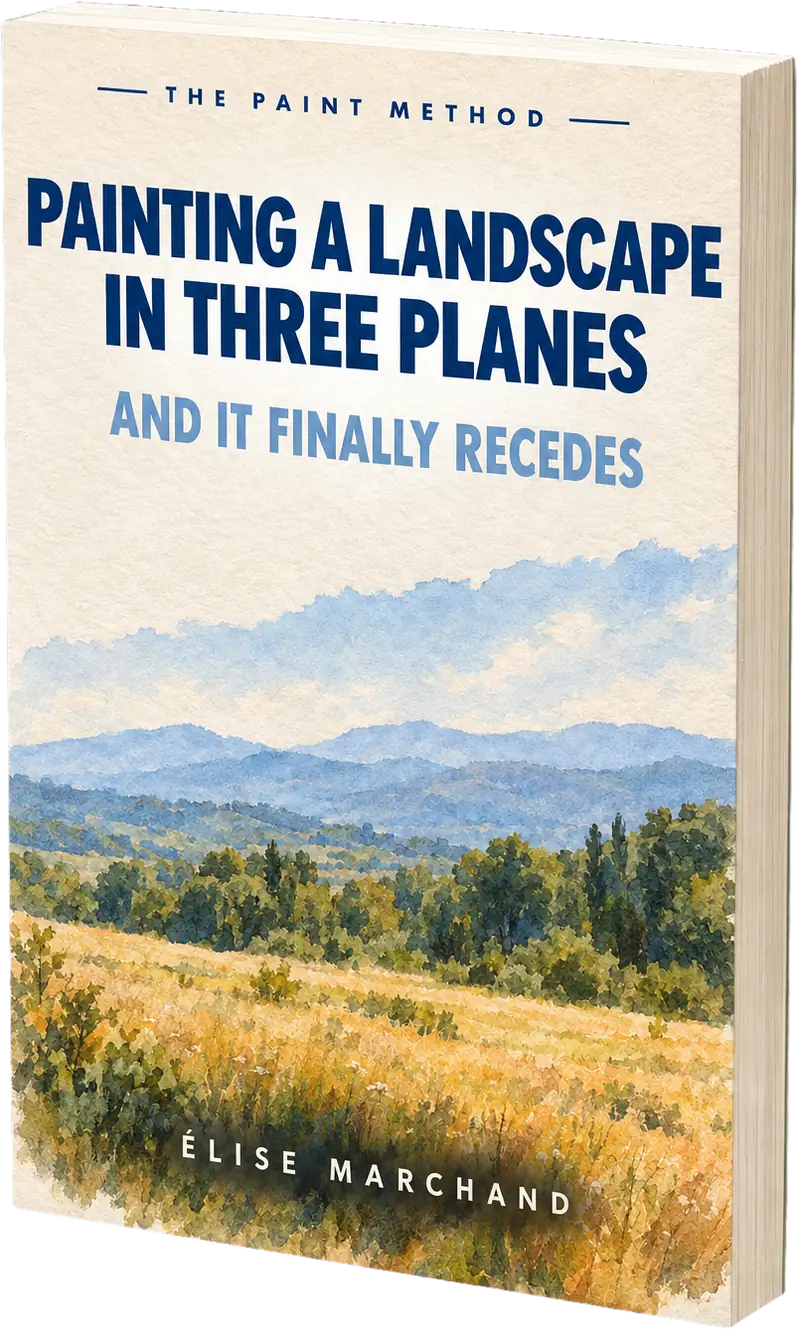
"Painting a Landscape in Three Planes"
A digital book in PDF, to read on your phone beside the sheet, on your computer, or printed if you prefer paper.
It is built around a constraint I set myself: every setting is shown on a dry sheet. You have to be able to compare what you see in front of you with what is on the page, and recognize your own case without having to describe it in words you do not have. There are sixty-five plates that show them, all in color.
Every lesson ends with a line that begins "By the end of this lesson, you can", and names something you do, not something you understand. That is what can be checked.
It is written in plain language, with no expert vocabulary. You need nothing but your box, an image of your own and a scrap of paper.
What is inside, part by part
Three lessons. We do not open on a blank sheet: we open on the last landscape that did not go back. What "three planes" means exactly, the list of what you get out, and the two lines drawn in the margin of an image you already have.
Six lessons. What a distance contains and what it does not. The three bands laid on a scrap, judged dry, and what the drying takes away. The lightness decided against the other two and never on its own. Why no sharp edge is entitled to be there. And the three signs that say the middle can go in. This is where you lay what is called elsewhere a wash, a broad and very diluted layer.
Six lessons. The band you look at, so the one you put too much into. The gap in lightness with the far distance, decided beforehand. The test to meet when the color dirties. The shapes that read without being detailed. The join that does not cut the sheet in two. And the three end signs, including the one that cannot be caught up.
Six lessons. What a front really does in a landscape. The one sharp edge of the sheet: how many, where, and what it costs the rest. The density that fills the grain. The grass and the stones, decided by their place and their lightness. The join with the middle. And the check from three feet away.
Five lessons. From the furthest to the nearest, with the demonstration made on two sheets, the same image both ways round. The list written before wetting, in six lines. The two waits and what you do with them. The three things a laid plane imposes on the next one, and why laying transparent layers one over another, what is called a glaze, does not send back a plane that has become too dense. And the one case where the order is reversed.
Five lessons, taken step by step: the mountain in the mist, the field and the line of trees, the seashore, the track that comes into the sheet, and the house in the middle. Each one takes up the three settings and the order of laying on a case where one of the three is difficult.
Six lessons. Mist and snow, when lightness no longer separates anything. The light coming from behind, when the gap opens right up. The landscape with two planes, where the middle is empty. The plane that comes forward and its three causes. What this book has not taught you and where that is. And the check in six points.
The form of the three ways in, the three planes card with its nine setting boxes, the card of my three bands where you stick your dry trials, the order of laying list in six lines, and the check card in six points with its "does not apply" boxes.
You don't need a new subject to check.
A landscape you painted before, and that refuses to recede, will do.
Tonight you can sort it into three planes and see which of the three is at fault: the far one, the middle one, or the one in front.
Depth is not added at the end. It is decided in the order of the planes, before the first color.
And you?
Which landscape will you sort first?
Your digital book, today
- The complete book in PDF: 37 lessons, 7 parts, 65 color plates (value: $47)
- The five printable forms, including the three planes card, filled in before the brush is loaded
- The check in six points, run on the dry sheet, from three feet away
- The five common landscapes, taken from the sorting of the image through to the dry sheet
Value: $47 → today:
The usual price of this book is $47. Today, it is $17.
Lifetime access, to read and reread at your own pace, on whatever you like.
100% digital access, immediate. Nothing is shipped.
You get your access by email, within a minute of your order.
30-day guarantee, no conditions
Read the book. Sort one of your images into three planes, tonight, without painting. Lay your three bands on a scrap and watch them dry. If within 30 days you feel it brings you nothing, write to contact@thepaintmethod.com and you are refunded in full.
No form, no justification, no questions. And you keep the book: I would not know how to take it back anyway.
In other words: either your three planes finally count, or this book costs you nothing. The only risk left is closing this page and painting one more landscape where everything sits at the same distance.
P.S. If you remember one thing from this page, remember this: a landscape gets sorted before it gets painted. Three bands of distance, three settings each, and a laying from the furthest to the nearest. As long as the image is not sorted, you are painting pieces, and pieces all sit at the same distance.
P.P.S. The book is $17 today instead of $47, and it is covered by the 30-day guarantee. You can read it tonight, draw your two lines on an image you already have, and decide afterwards.