How to lay a color and never come back to it, and what to do with a painting already damaged when going back over it only makes things worse.
Because it is not your first layer that ruins the painting, it is your third: every time the brush comes back onto a color already laid, it costs the paper some light, and that light is never given back. No prior knowledge is needed, nothing to revise, no school word to know in advance; you do need to have painted a few paintings already, because this whole book is judged on yours.
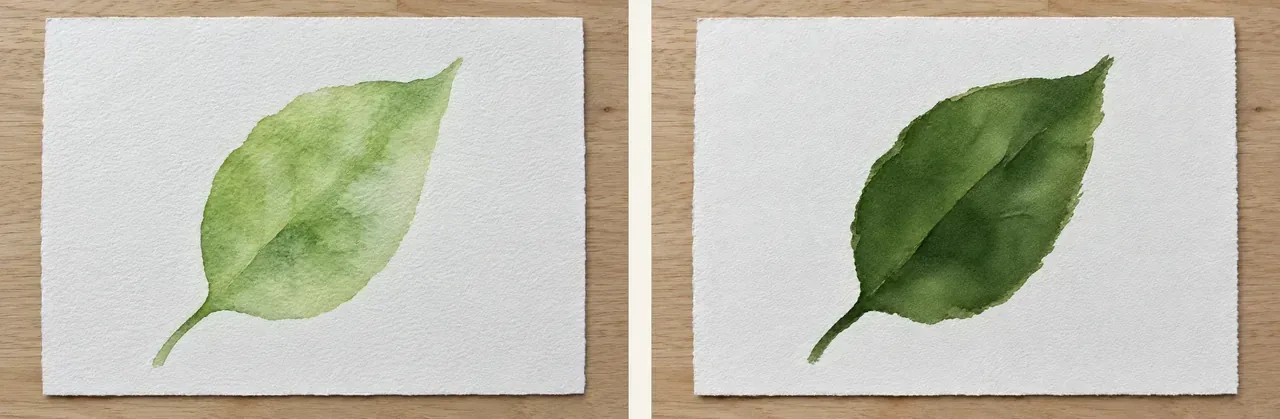
The same color, the same water, the same paper. What changed is the number of times the brush came back onto it.
The digital book "Why It Gets Worse When You Go Back Over It", to read and apply tonight, with a sheet of paper and your box beside you.
Keep reading if you are tired of ruining a painting while trying to improve it:
- Why the color turns heavier and the paper duller with every return of the brush, and why one more layer changes nothing.
- How a stroke is decided before you wet the brush: where it goes, what size it is, how dense it is, written in three columns before you begin.
- The half-dry, the moment when a layer is no longer wet and not yet dry: it is the only one where an added stroke tears instead of laying, and you recognize it by eye, without putting a finger on it.
- The stroke count, written in the corner of the sheet before you begin, and the three questions that replace the feeling at the end.
- The three ways out of a painting already damaged, lifting, cropping, redoing it beside, and why repainting over it is not one of them.
- What cannot be rescued, said early and said plainly, so that you do not lose an evening on a sheet that is not coming back.
Dear reader,
You have painted something. The first layer is laid, it is a little pale, a little soft, it does not say what you wanted it to say. So you go back in.
And you know the rest. A second time, a third, and with every return the color gets heavier. You put the brush down telling yourself it is spoiled again, and you still cannot say at which point exactly it tipped over. The next day the sheet is in a pile you show to nobody.
From: Élise Marchand, for The Paint Method
Place: a kitchen table, somewhere in France
It is not the first layer that ruins the painting, it is the third
What changed everything for me was not a better box or a better paper. It was understanding that the gesture damaging my paintings was exactly the one I was making to save them.
A watercolor holds its light from the paper, not from the color. Every time the brush comes back onto a color already laid, it takes a little of it away, and there is no way to give it back. The second layer costs little. The third costs everything.
From that comes the rule that holds the whole book, and it fits on one line: decide before you wet the brush, lay the stroke in one go, and do not come back onto a layer at the half-dry. It is the gesture the whole collection quotes without ever teaching, because it takes a whole book. This is that book.
And for the paintings you have already gone back over too often, three ways out are left, and not one of them adds a layer. Lifting color off instead of putting more on. Cutting the sheet with scissors to keep the part that holds. Redoing the same subject small, right away, on another sheet. Repainting over it is the fourth, the one the hand takes by itself, and the only one of the four that makes things worse.
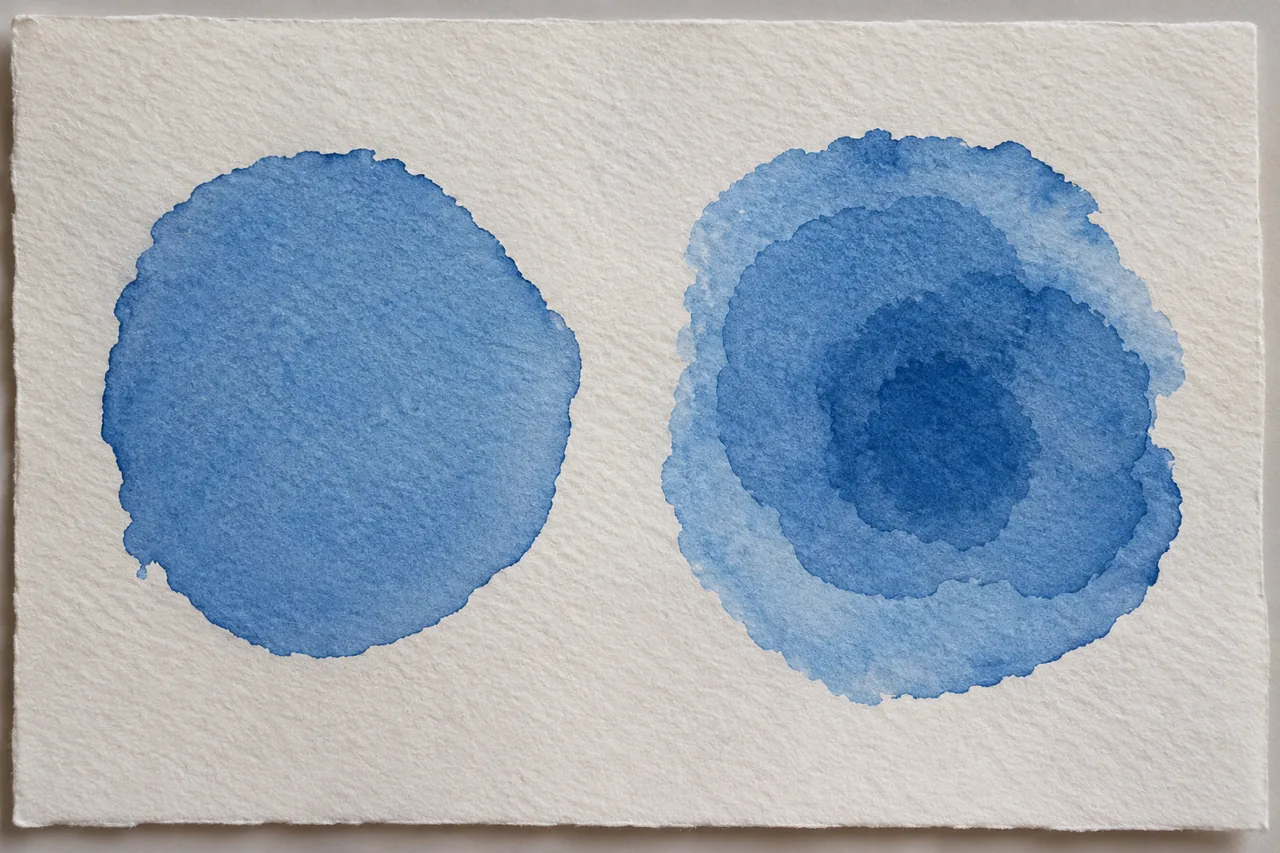
You can try this tonight, before deciding anything at all on this page: lay two patches of the same color on a sheet, leave the first one alone, go over the second twice, and wait until they are dry. The sheet will answer you on its own.
Lay it, wait, stop, rescue: in that order
Lay it. A stroke is one brush load laid in a single move and left as it is until it is dry. It is decided beforehand: where it goes, what size, how dense, and with how much water it will hold until it dries. A brush bigger than the one you were going to take does half the work.
Wait. A layer goes through three states, and only one of them is dangerous: the half-dry, when the shine has gone out but the paper is not yet fully matte. A stroke laid there tears the layer underneath instead of laying on top of it. The book has you measure with a timer how long YOUR half-dry lasts, on YOUR paper, and gives you a gesture to make during that time so that you do not touch it.
Stop. Not on a feeling. On the number of strokes you wrote in the corner of the sheet before you began, on three questions put to a dry painting, and on a step back of one yard taken before every closing stroke.
Rescue. The three ways out, and the test that says which one to take: it is how far the fault spreads that decides, not what you feel like doing.
The order matters. You learn to stop damaging before you learn to rescue, otherwise you spend your life rescuing.
At this point, you have two options
The second option asks for one read and a few evenings of short exercises. The first costs sheets, time, and the wish to get the box out again.
Imagine
- Imagine laying a color, putting the brush back on the table, and never touching it again, because you had decided beforehand what that stroke had to do.
- Imagine seeing a fault appear while it dries and not touching it, because you know the layer is at the half-dry and that anything you did there would tear it all up.
- Imagine stopping because you have reached the number of strokes written in the corner of the sheet, and not because you are tired of searching.
- Imagine picking up a damaged painting, choosing a way out, carrying it through in ten minutes, and putting it back on the pile knowing what you learned from it.
What you will be able to do when you close it
- Write a stroke down before you wet the brush: where it goes, what size, how dense, on one line, and lay it exactly as written.
- Load the brush for the whole stroke, in one go, and carry it to the end without reloading.
- Recognize the half-dry by eye, with the light coming across the layer, without putting a finger on it, and know how long it lasts on your paper.
- Announce how many strokes a subject asks for, write it in the corner of the sheet, and say at the end by how much you were wrong.
- Stop a painting on three questions and a step back, instead of a feeling.
- In front of a damaged painting, choose one of the three ways out according to how far the fault spreads, and carry it through without adding a layer.
- Recognize a sheet that is not coming back, date it, keep it on the pile, and move on to the next one.
What you need to have, and what you must not buy
You need nothing more than what you already own. That is a rule I set myself while writing this book, and the materials list was written after the thirty-six lessons, not before, to be sure that not one of them asked for a purchase.
Here it is in full: your box, exactly as it is, a schoolchild's box included; your brushes, exactly as they are; your paper and scraps of that same paper, because the grain of the scrap has to be the same as your sheet's, otherwise the test teaches you nothing; water, paper towel and a cotton rag, an old kitchen cloth will do; a pair of desk scissors; a pencil and a few sheets of ordinary paper; something to count minutes with; a lamp you can tilt, or a window; and your finished paintings, even the ones you do not like.
That is all. No color to buy, no paper to buy, no accessory, no app to install and no code to scan.
For which materials, and for whom
The book is written for watercolor, and watercolor is what drives the examples. The gesture holds in the same way for gouache and for acrylic: those are three water-based mediums, and in all three, a color laid down and then taken up again before it is dry gets dirty. What changes from one to the next is what covers and what lets the paper through, that is, opacity, and the book points it out where it matters. Oil is outside this book, and I would rather say it here than on page fifty: in oil, coming back onto a color is the normal gesture, and the rule of this book would be false there.
This is for you if you have already painted a few paintings and you have already gone back over one and regretted it. No prior knowledge is needed: nothing to revise, no school word to know in advance. You want a gesture, not a state of mind.
This is not for you if you have never held a brush: one lesson has you paint a small subject so that you have something to compare, but that is a stopgap, not a front door. If you are after a course on composition, on framing or on choosing a subject: this book does not cover that, it speaks only of the gesture and of its repairs. If you paint in oil, this book is not yours.
The questions you are asking yourself
"So am I never allowed to come back onto a layer?" You are, once, and on written conditions. A second layer laid on a dry area, because you had decided it before you began, is not a second pass. A whole lesson is given to it, and it is the only return this book allows.
"And my paintings that are already damaged, do I throw them away?" No. You keep them, dated in pencil on the back, and part 4 has you choose one of the three ways out for each of them, according to how far the fault spreads. One lesson also says plainly what cannot be rescued.
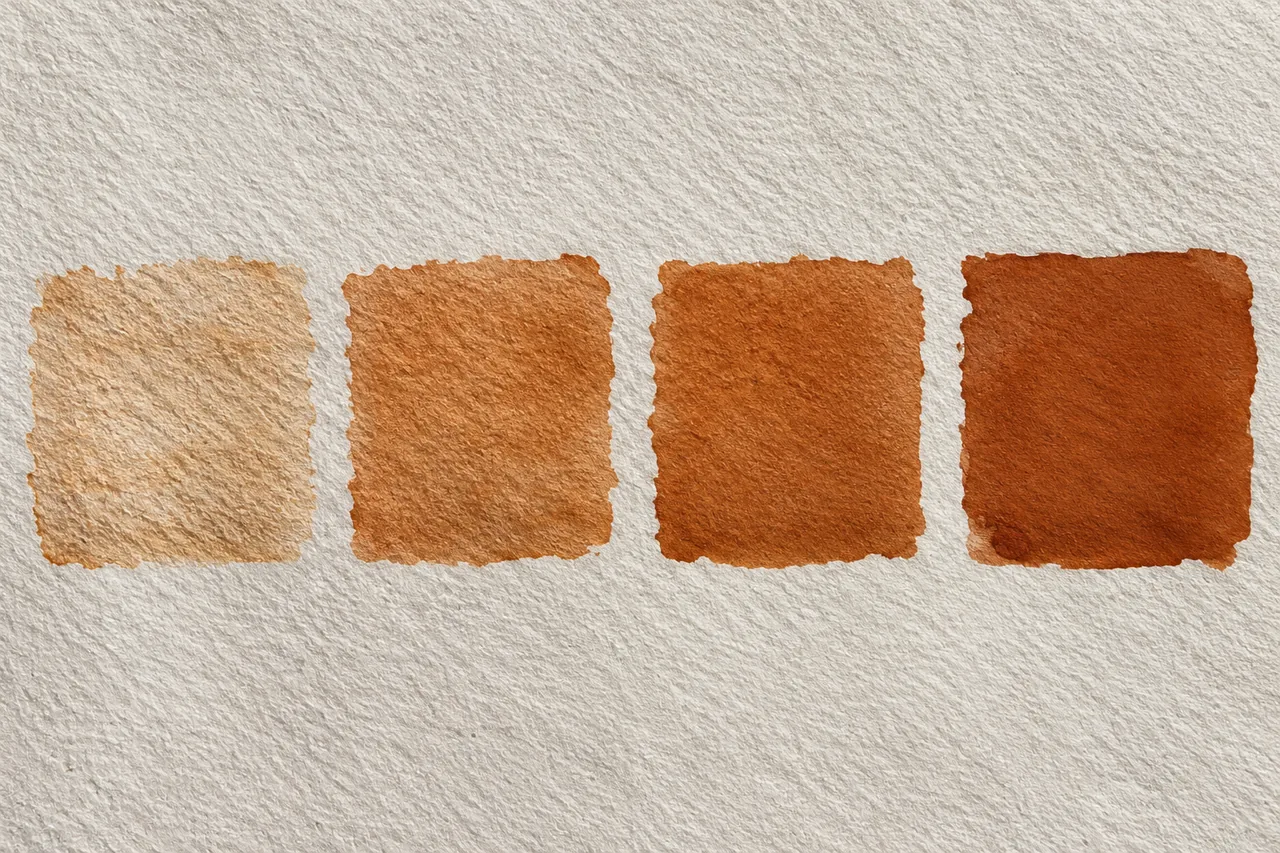
"My paper is cheap, that must be it." Maybe, in part. The book does not conclude in your place: it has you measure how many passes YOUR paper takes, on the four-pass band, and it is your band that answers.
"I cannot stop myself from touching it." That is the most common case, and it is not a matter of willpower: it is a moment, the half-dry, and a waiting gesture to decide in advance. The book has you write that gesture down before the session, not during it.
"I do not have the time." The exercises run from fifteen minutes to a full session, drying included, and the workbook gives you the time for each one before you start it, and you do not do them all at once: you do the one belonging to the lesson you have just read.
"I am afraid of spoiling a good sheet." You will not touch your good sheet. The tests are done on scraps of that same paper, and one sheet torn in four gives you four scraps.
"And if I need help?" You write to contact@thepaintmethod.com. A real address, on this page, before you buy.
I am pleased to introduce my digital book:
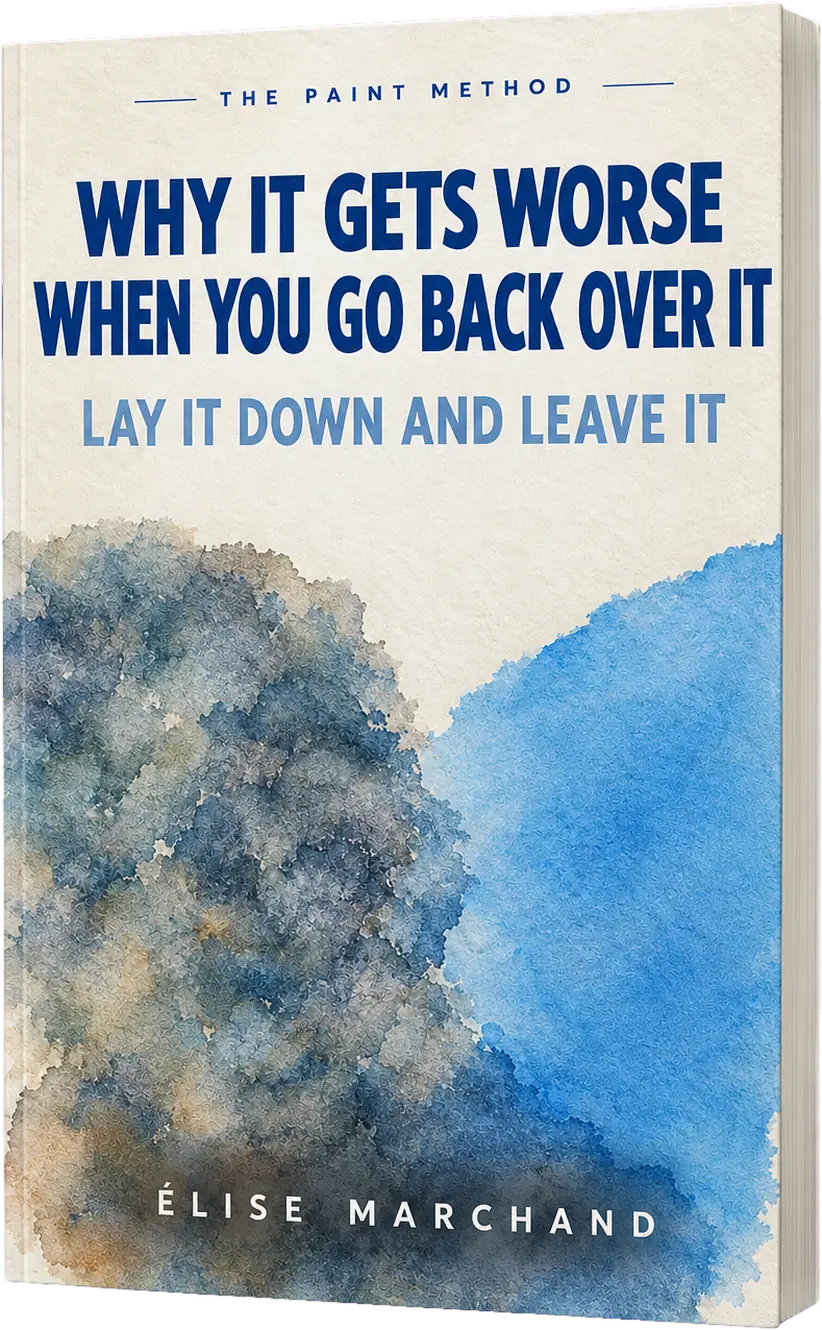
"Why It Gets Worse When You Go Back Over It"
A digital book in PDF, to read on your phone beside the paper, on your computer, or printed if you prefer paper.
It is built around a constraint I set myself: one picture per case. You have to be able to compare what you see on your sheet with what is on the page, and recognize your case without having to describe it with words you do not have. There are sixty-two of them.
Every lesson ends with a line that begins "By the end of this lesson, you can", and names something you do, not something you understand. That is what can be checked.
It is written in plain language, with no expert vocabulary. You need nothing but your box, your paper and the paintings you have already made.
What is inside, part by part
Three lessons. We do not open on a rule: we open on two patches of the same color, one laid in a single move, the other taken up twice more, and we wait until they are dry. Then the four-pass band, which tells you how many your paper takes. Then, in front of your last painting, which of the three reasons sent you back into it.
Six lessons. Deciding before you wet the brush. Loading for the whole stroke. Taking a brush bigger than the one you were going to take. How much water a stroke needs to hold until it is dry. Where a stroke stops. And laying it, then doing nothing more.
Five lessons. The three states of a layer. Recognizing the half-dry by eye, with the light coming across it. What a stroke really does there. The waiting gesture, decided in advance. And coming back onto a dry layer, on what condition: this is where, once and only once, we explain the glaze and where it fits inside this method.
Six lessons. The number of strokes announced before you begin. The three questions of the end. The step back. The painting you look at again the next day. The gesture that replaces the touch-up. And what this book will never say about your painting: it does not say whether it is beautiful, and it does not measure whether it is short of dark and light, which is the whole subject of another book in the collection.
Seven lessons. The fourth way out, the one the hand takes by itself. Lifting within the minute, then lifting on a dry layer. Cropping with scissors. Redoing it beside, straight away. Choosing your way out on how far the fault spreads. And what cannot be rescued, said before the exercises and not after.
Four lessons. The same subject twice in the same session. How many strokes a subject really takes. Stopping half way and picking it up tomorrow without undoing everything. And the stack: your paintings kept, the damaged ones included, dated on the back.
Five lessons. Three step-by-step exercises: the four-pass band, the same subject painted twice and then read point by point, and three damaged paintings with one way out each. We close on the six-point closing form, run on your last painting.
The stroke form, the four-pass band to copy onto your own paper, the half-dry form with its two measured timings, the three ways out form, and the six-point closing form.
You don't need a fresh painting to start.
The one you spoiled by going back over it will do perfectly well.
Tonight you will be able to say what on that sheet can still be saved and what cannot, and why a third layer made it worse.
And on the next one, you will know the moment your hand has to lift.
And you?
Which painting will you stop trying to rescue?
Your digital book, today
- The complete book in PDF: 36 lessons, 7 parts, 62 color plates (value: $47)
- The five printable forms, including the four-pass band and the half-dry form
- The six-point closing form, to fill in before you stop
- Lifetime access, to read and reread at your own pace, on whatever you like
Value: $47 → today:
The usual price of this book is $47. Today, it is $17.
100% digital access, immediate. Nothing is shipped.
You get your lifetime access by email, within a minute of your order.
30-day guarantee, no conditions
Read the book. Do the first lesson tonight, the two patches and the drying. Do the three exercises in the last part. If within 30 days you feel it brings you nothing, write to contact@thepaintmethod.com and you are refunded in full.
No form, no justification, no questions. And you keep the book: I would not know how to take it back anyway.
In other words: either you finally lay a color without coming back to it, or this book costs you nothing. The only risk left is closing this page and damaging one more painting while trying to improve it.
P.S. If you remember one thing from this page, remember this: the light of a watercolor comes from the paper, and every return of the brush takes a little of it away without ever giving it back. Decide before, lay it in one go, let it dry. And when it is already damaged, three ways out are left, and repainting over it is none of them.
P.P.S. The book is $17 today instead of $47, and it is covered by the 30-day guarantee. You can read it tonight, lay your two patches, and decide afterwards.