How to lay a flower by its overall shape, before the first petal, with the box you already own, so that it stops looking cut out of paper.
Because a stiff flower is not a matter of the hand: it comes from the order in which it was laid. That order holds in four pieces, and not one of them is a petal. No prior knowledge of painting is needed: nothing to revise, no school word to know in advance. You only need to know how to load a brush and lay a color, because this book starts exactly there.
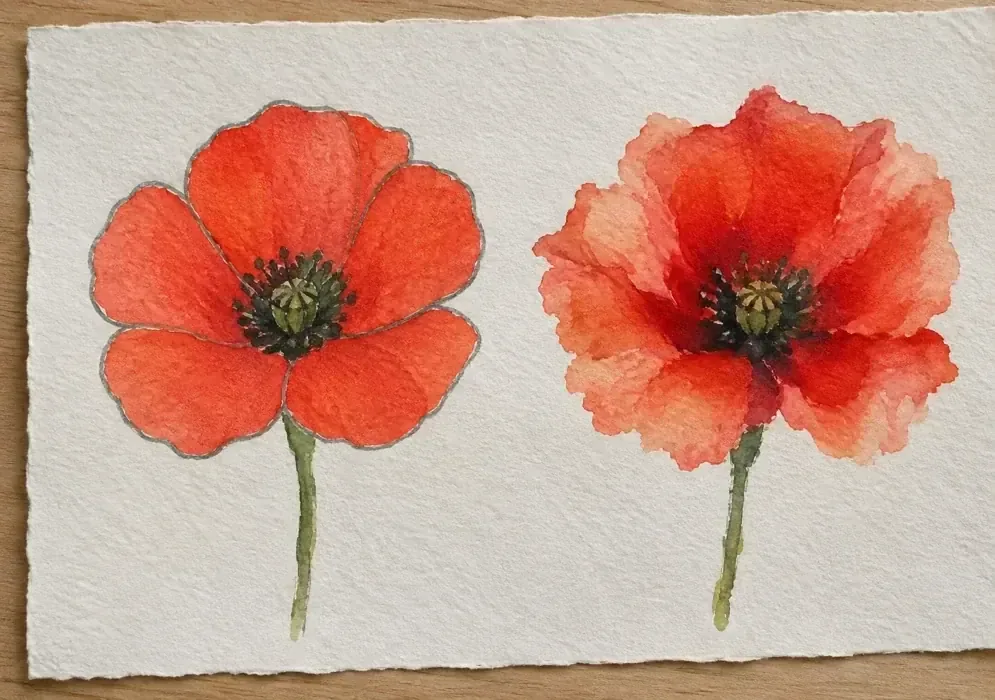
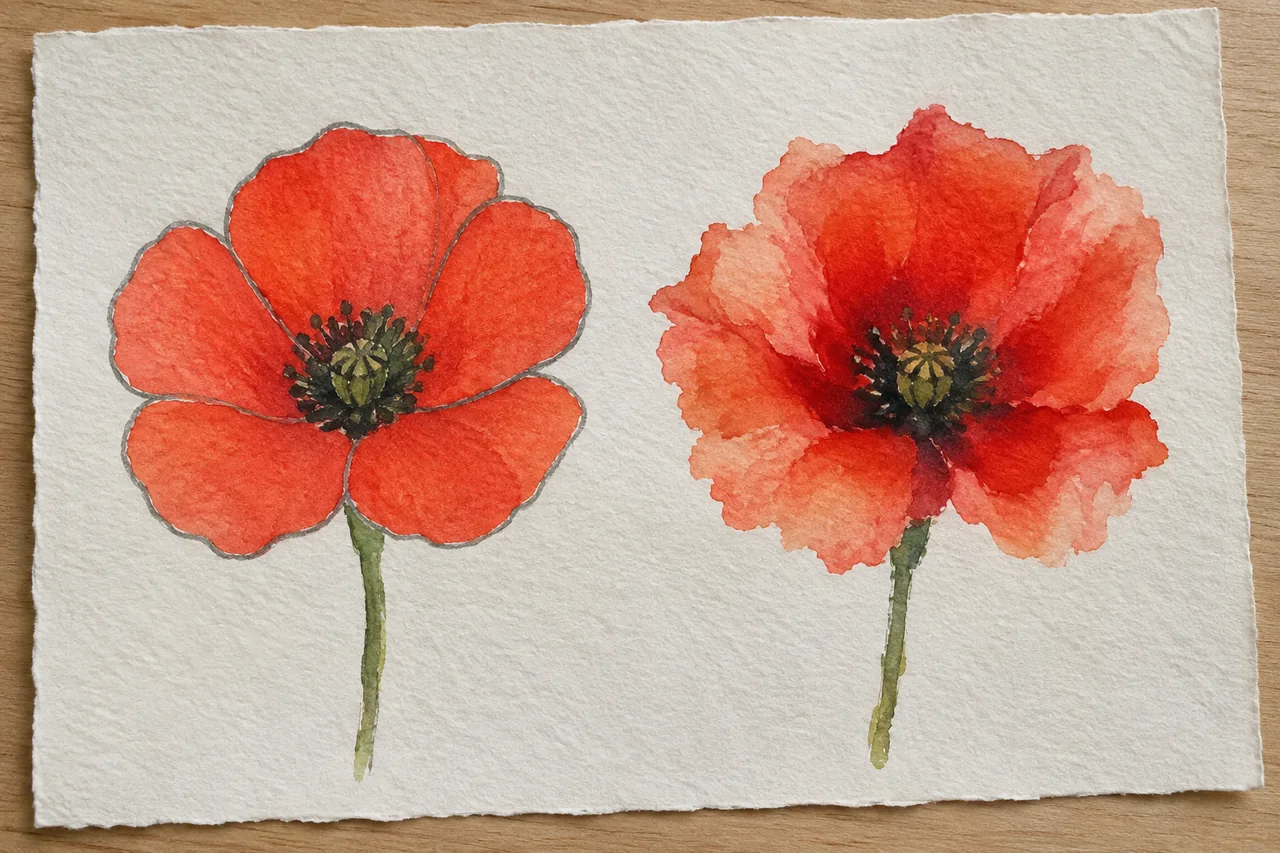
The same subject, the same paper, the same brush. What changed is the order in which the four pieces were laid.
The digital book "Painting Flowers Without Copying Them", to read and apply tonight, with a flower standing in a glass of water in front of you.
Keep reading if your flowers come out clean, stiff, and looking cut out:
- Why a flower painted petal by petal turns into a filled-in outline, and why it shows even when the color is lovely.
- The four pieces of a flower, in their order: the overall shape, the white of the paper kept, the heart, then the green. Not one of them is a petal, and the order is not up for discussion.
- Why the white of a flower gets decided before the brush is loaded, and why nothing gives it back once it is lost.
- At what exact moment the heart can go in, while the color is still shining, and what one laid too late looks like.
- How the green of the leaves eats a flower that was going well, and the one test that keeps it on a leash.
Dear reader,
You have painted flowers before. You may own a book of models, with printed outlines to fill in, and your flowers look like what they are: filled-in outlines.
They are clean. They are stiff. The petals look like sheet metal, the green swallows everything, and the moment you step away from the model it goes muddy. You close the box telling yourself you do not have the hand, when what you are missing is an order nobody ever gave you.
From: Élise Marchand, for The Paint Method
Place: a kitchen table, somewhere in France
A flower has a shape before it has petals
What changed everything for me was not a better brush. It was giving up starting with the petal, and starting with the overall shape.
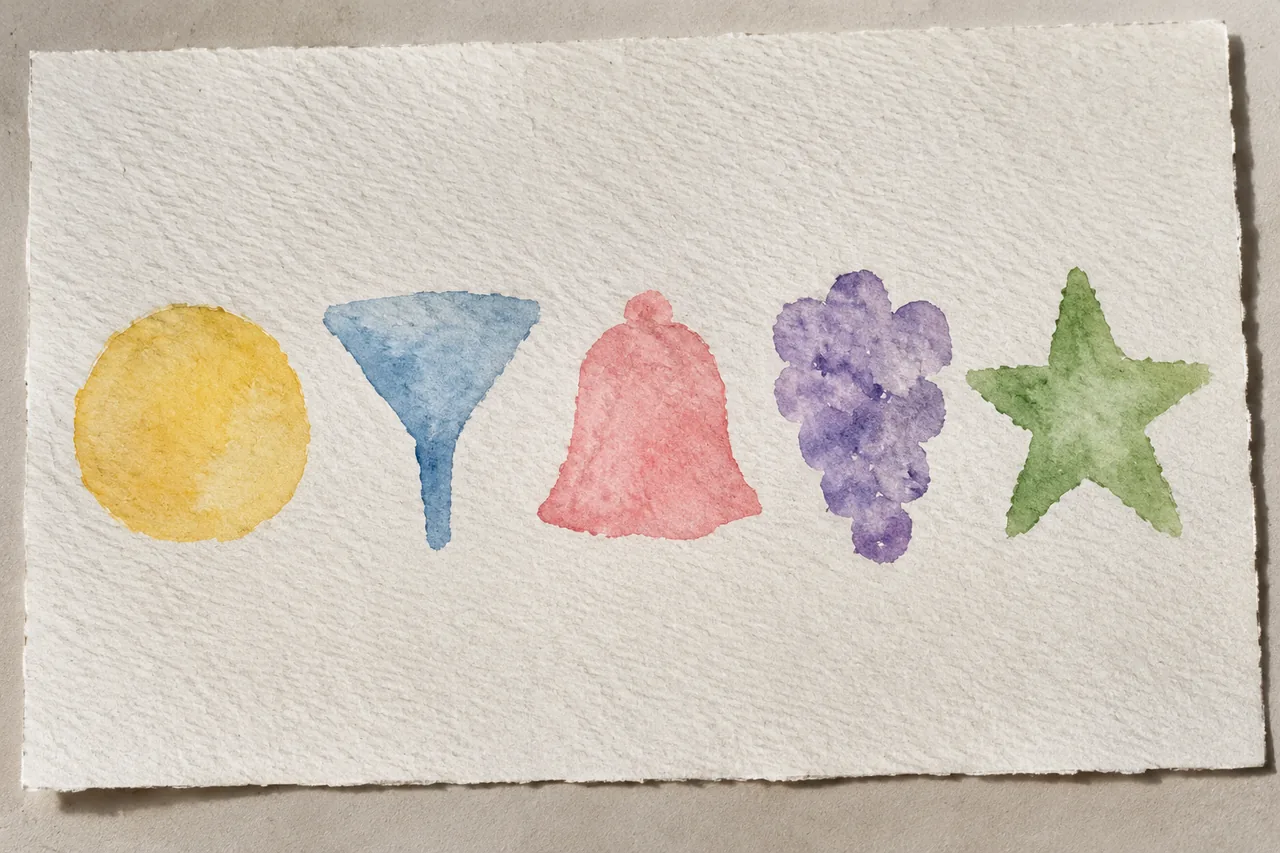
A common flower fits one of five shapes: the round, the funnel, the bell, the cluster, the star. That shape can be named from three feet away without counting a single petal, and it gets laid in one go, with the brush, with no pencil line underneath. The petals come out of it afterwards, in two or three strokes, and they get laid into the color, never beside it.
And this has to be said at once, because the title can be taken the wrong way: "without copying them" is aimed at the printed outlines of model books, not at your own photograph. This book asks you, on the contrary, to have a flower in front of you, real in a glass of water or in a picture, and it tells you what to take out of it before the brush is loaded. You take one single thing from it: its overall shape.
That looking costs nothing. It takes ten minutes. You can do it tonight on one of your dry sheets, before deciding anything at all on this page. But naming the shape is not enough: you need the four pieces, and you need to lay them in order.
The four pieces, in this order and in no other
The mass. The overall shape of the flower, laid in one go, with the brush, with nothing drawn underneath. It goes in through the widest part and gets pushed out toward the edges. In places its edge stops dead, elsewhere it fades out into the paper: it is that breathing edge that keeps a flower from looking cut out.
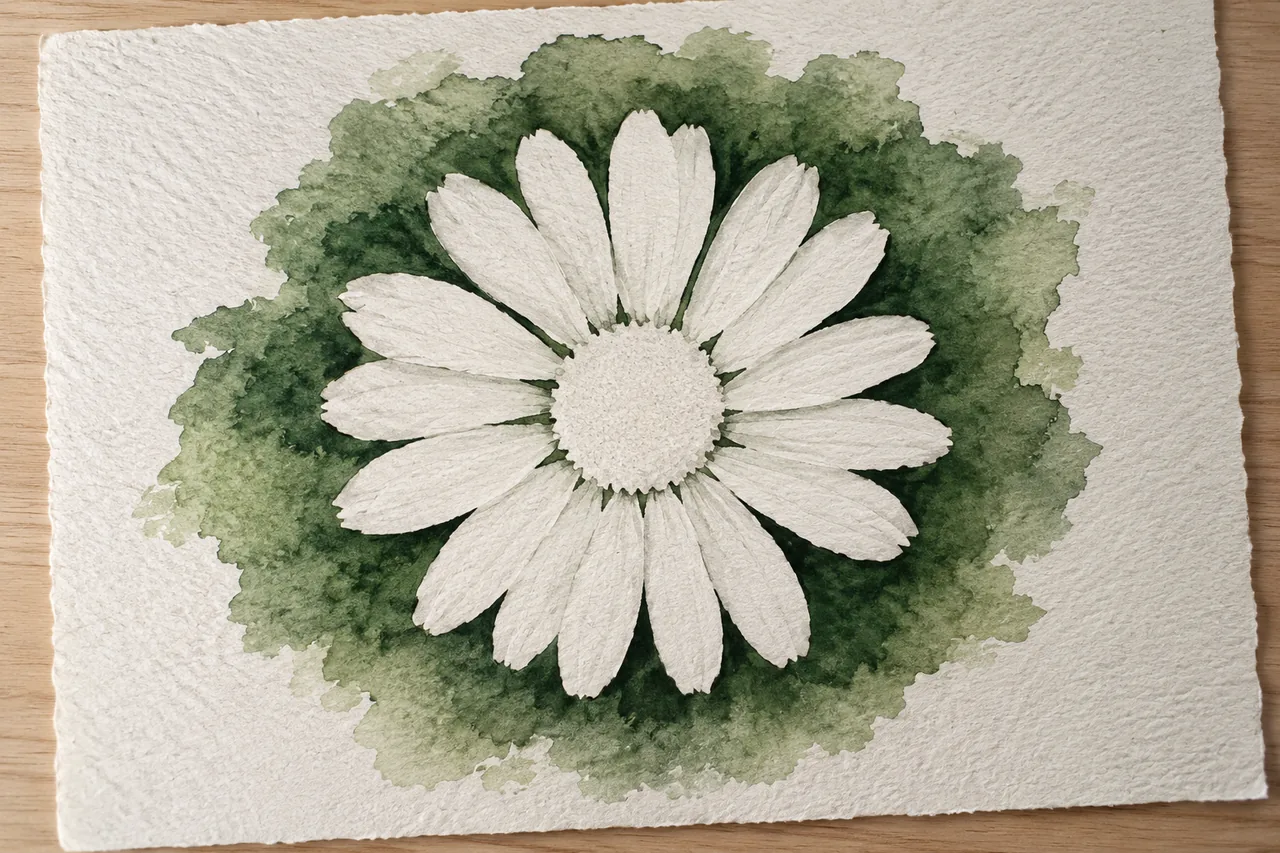
The flower's white. Two or three places on the paper you decide not to touch, written in the margin before the brush is loaded. In watercolor white is not laid on: whatever is not touched stays white, and nothing gives it back afterwards. A white flower takes that idea all the way, and is barely painted at all.
The heart. The darkest point, where the petals meet. It goes in while the mass is still shining, and it blends by itself. Laid on dry paper it makes a hard edge in the middle of the flower, and a hard edge in the middle of a flower makes it look like a badge stuck on.
The held-back green. It arrives last and it arrives small. The test is easy to check and it asks for no recipe: a green lighter than the flower, and never more vivid than it. Almost every flower that goes wrong in this book goes wrong through its leaves, never through its flower.
The order counts: the mass first, because the white is kept inside it, because the heart can only go in while it shines, and because a green laid before the flower stands in front of it for good.
At this point, you have two options
The second option asks for one read and one evening. The first costs sheets you no longer dare show, and a box you end up putting away.
Imagine
- Imagine looking at the flower in front of you and writing down its overall shape out of the five, before you have touched a brush.
- Imagine laying that shape in one go and seeing, once it is dry, that two of its edges faded out into the paper instead of stopping on a line.
- Imagine a white flower appearing when the only color you laid was around it, without touching a single one of its petals.
- Imagine looking at one of your old sheets and being able to say, piece by piece, which one was missing. Not "it went wrong": that is the green, and that is a heart laid too late.
What you will be able to do when you close it
- Name the overall shape of a flower in front of you out of the five, and write it down before touching a brush.
- Lay that shape in one go, going in through its widest part, with no pencil line underneath.
- Write in the margin the two or three places you will keep white, and go around them in one continuous move.
- Sort the whites of a dry flower into three: held, closed up, too big.
- Bring out a white flower without laying color on a single one of its petals.
- Point a finger at the place where the heart falls, lay it there with no hard edge, and try your dark on an offcut before using it.
- Decide whether a green suits your flower by laying it dry beside the flower.
- Run the six-point check on your own sheet, from three feet away, tick "not applicable" wherever your flower calls for it, and say which of the remaining points was missing.
What you need to have, and what you must not buy
You need nothing more than what you already own. That is a rule I set myself while writing this book, and I held to it all the way through: no lesson in it answers a fault with new equipment.
The materials list asks you to buy nothing: the brush that carries a point and holds water, the one you already use; the finest one in your case, which stays out of reach of your hand until the end; your box, exactly as it is; paper that takes water, and its offcuts; water, in two glasses rather than one, and a rag; an ordinary graphite pencil, which writes in the margin and never under the color. The grain of the offcuts has to be the grain of your sheet, or the test tells you nothing about what will happen on it.
And a flower, real or in a picture. A flower from a florist or picked at the side of a path, standing in the second glass at eye level. If you have none tonight, the book says exactly what to look at instead, and the rest does not change by a line.
That is all. No color to buy, no paper to buy, nothing to add.
Which paint it is written for, who it is for, and what this book is not
The book is written for watercolor, and watercolor governs everything here: the white is the white of the paper, it gets decided before painting, and nothing gives it back afterwards. The four pieces hold for gouache and for acrylic laid in thin layers as well, which are two other water-based mediums. One single thing changes with those two, and it is flagged where it matters: a color that has opacity gets laid back over the top, so it does not give back the flower's white, it replaces it. Oil paint is outside this book.
This is for you if you have already painted a few sheets and your flowers come out stiff. No school knowledge is needed, and you have nothing to revise. You want to understand the order in which a flower gets laid, not follow one more model.
This is not a book of models. There is no outline to trace, no plate to color in, no flower to reproduce stroke for stroke.
This is not a book about mixing. No color is named by its tube and no recipe is given. The book says which green to obtain and how to check it on an offcut; making it is the whole subject of another book in the collection.
This is not a book about composition. Where a flower sits on the sheet is not its subject: it lays one flower, it does not arrange a bouquet. In the same way it does not deal with the values of a whole painting, the dark and the light measured from one end of the sheet to the other; another book in the collection teaches those under that name, and this one speaks of dark only inside a flower.
This is not a book about backgrounds or vases, and it is not a book about what you do when it has gone wrong. It stops at one flower that holds on its sheet, and it promises no finished bouquet, no painting to frame, and no deadline.
The questions you are asking yourself
"So I am not allowed to look at a photo of a flower?" You are, and you have to. "Without copying them" is aimed at the printed outlines of model books, not at your own picture. The book asks you to have a flower in front of you, real or in a picture, and it teaches you to take one single thing from it before the brush is loaded: its overall shape.
"I cannot draw." All the better, there is nothing to draw. The overall shape goes in with the brush, not with the pencil, and the pencil in this book only writes in the margin and on the forms.
"My box is not the same as yours." That is exactly why nothing here rests on the name of a color. The book gives you tests to meet with the box you own, and the way to check them on an offcut laid beside your dry flower.
"My flowers are always stiff, it is my hand." It is not your hand. A stiff flower comes from an edge followed all the way around, and from a petal laid beside the color instead of into it. Those are two moves, and both of them can be changed.
"I do not have the time." A whole flower fits in one evening, and the first tries get laid on an offcut in ten minutes. The rest you will open piece by piece, at the moment you need it.
"I am afraid of spoiling a good sheet." You will not touch your good sheet. Everything that gets tried gets tried on an offcut of the same paper, and that is exactly what it is for.
"I am just not gifted." Nobody works out on their own that a flower gets laid by its overall shape and that its white gets decided beforehand. It is not talent, it is an order. Nobody gave it to you, and you drew a conclusion about yourself out of a silence.
"And if I need help?" You write to contact@thepaintmethod.com. A real address, on this page, before you buy.
I am pleased to introduce my digital book:
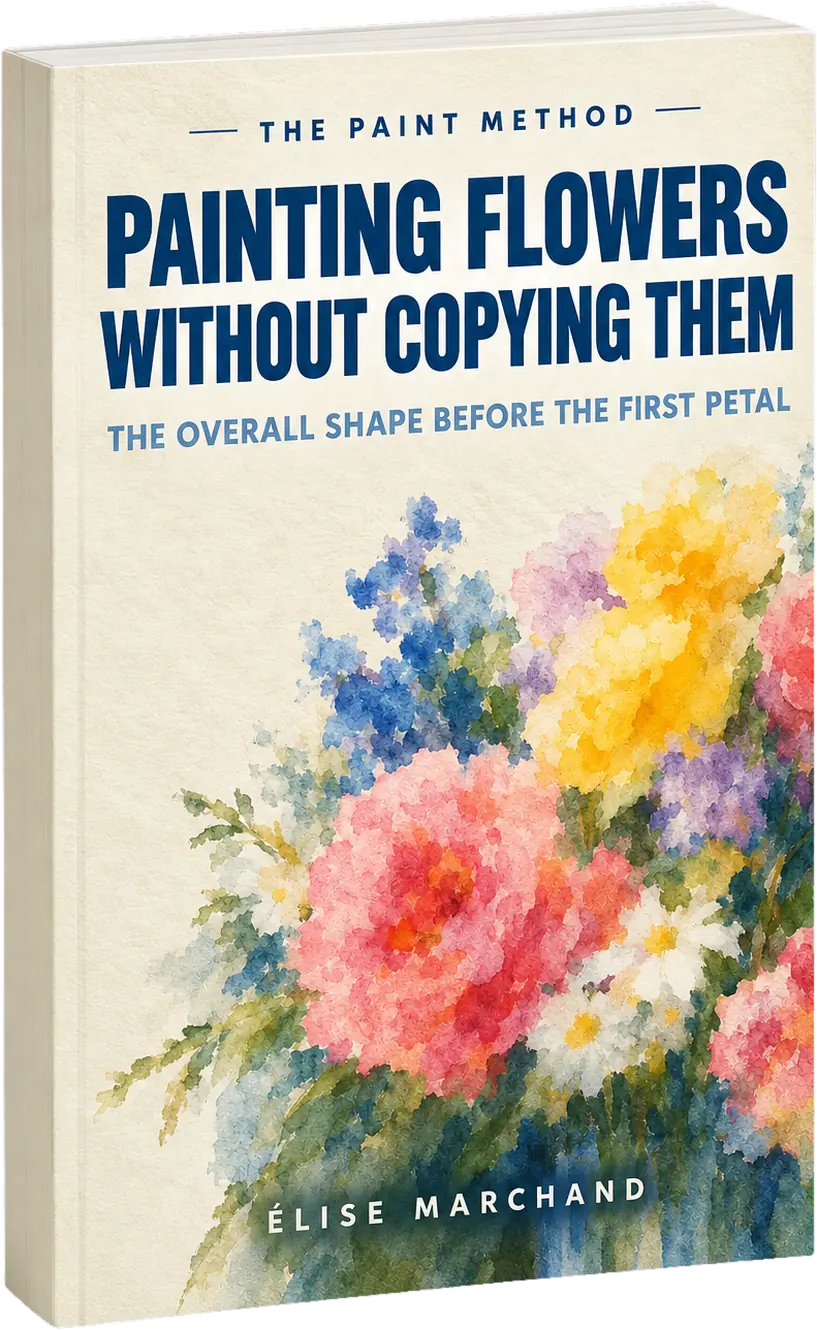
"Painting Flowers Without Copying Them"
A digital book in PDF, to read on your phone beside the sheet, on your computer, or printed if you prefer paper.
It is built around a constraint I set myself: one image per mechanism. You have to be able to compare what you see on your sheet with what is on the page, and recognize your own case without having to describe it in words you do not have. There are sixty-three of them, all in color.
Every lesson ends with a line that begins "By the end of this lesson, you can", and names something you do, not something you understand. That is what can be checked.
It is written in plain language, with no expert vocabulary. You need nothing but your box, a flower and an offcut of paper.
What is inside, part by part
Three lessons. We do not open on a blank sheet: we open on your last flower that went wrong, dry, and on the exact place where it stopped being a flower and became a filled-in outline. Then we stand a flower in a glass of water, at eye level.
Six lessons. The five overall shapes. The mass laid with the brush, with nothing underneath. Where the color goes in. The breathing edge. The petals coming out of the mass in three strokes. And the three signs that say it is finished. This is where you lay what is called elsewhere a wash, a broad and very diluted layer; a glaze, which names transparent layers laid one over another, does not come into this book, because the color here goes down in one go inside the shape.
Six lessons. White is not laid on, it is kept. How many places, and which ones, written before the brush is loaded. Going around without slowing down. The white held, the white closed up, the white too big. And the white flower, where all the paper is kept.
Five lessons. Where it falls according to the overall shape. Why it goes into color that is still wet. A patch, not a drawing. The dark judged on the flower and not in the mixing dish. And the three or four fine lines, right at the end.
Six lessons. The green arrives last and it arrives small. The test to meet, checked on an offcut. The leaf, which is a mass too. The stem that holds the flower without going through it. And what you take away when the flower has been eaten.
Five step-by-step lessons, the four pieces taken up again in order on each one: the poppy, the daisy, the tulip, the hydrangea and the rose. Flowers you buy at a florist or pick at the side of a path.
Five lessons. Three flowers, not ten, and one single one whole. The laying order when they touch. What is behind, and why this book stops there. The six-point check with its "not applicable" boxes. And the same flower painted three times, changing one piece each time.
The form of the three ways in, the form of the flower in three parts, the four pieces form to fill in before the brush is loaded, the map of your greens, and the six-point check sheet. All of them blank: a form that came filled in would be a recipe, and a recipe never works twice.
You don't need to know how to draw a petal: the overall shape goes on with the brush.
That is precisely what makes you lose the flower.
Tonight you will know how to lay the overall shape before the first petal, and to spot, in your old bouquets, the exact moment you slipped into copying.
A painted flower reads from across the room. A copied one only reads up close.
And you?
Which bouquet will you take up again first?
Your digital book, today
- The complete book in PDF: 36 lessons, 7 parts, 63 color plates (value: $47)
- The five printable forms, including the four pieces form, filled in before the brush is loaded
- The six-point check, run on your dry sheet, from three feet away
- Lifetime access, to read and reread at your own pace, on whatever you like
Value: $47 → today:
The usual price of this book is $47. Today, it is $17.
100% digital access, immediate. Nothing is shipped.
You get your lifetime access by email, within a minute of your order.
30-day guarantee, no conditions
Read the book. Lay a flower tonight, by its overall shape, with two whites written in the margin. Run the six-point check on your dry sheet. If within 30 days you feel it brings you nothing, write to contact@thepaintmethod.com and you are refunded in full.
No form, no justification, no questions. And you keep the book: I would not know how to take it back anyway.
In other words: either your flowers stop looking cut out, or this book costs you nothing. The only risk left is closing this page and filling in one more outline.
P.S. If you remember one thing from this page, remember this: a flower has a shape before it has petals. As long as you start with the petal, you are filling in an outline, and no color catches that up. The overall shape, the white kept, the heart, the green: four pieces, in that order, and not one of them is a petal.
P.P.S. The book is $17 today instead of $47, and it is covered by the 30-day guarantee. You can read it tonight, stand a flower in a glass of water at eye level, and decide afterwards.