How to tell what a flat painting is missing, in one minute, with the phone you already own.
Because a painting that stays dull is almost never short of colors: it is short of dark and light, and your eyes cannot see it, because color lies to you. Two photos, turned black and white, laid side by side, and you see it in a minute. No prior knowledge is needed: nothing to revise, no school word to know in advance. You do need one painting of your own, dry, to put in front of you.
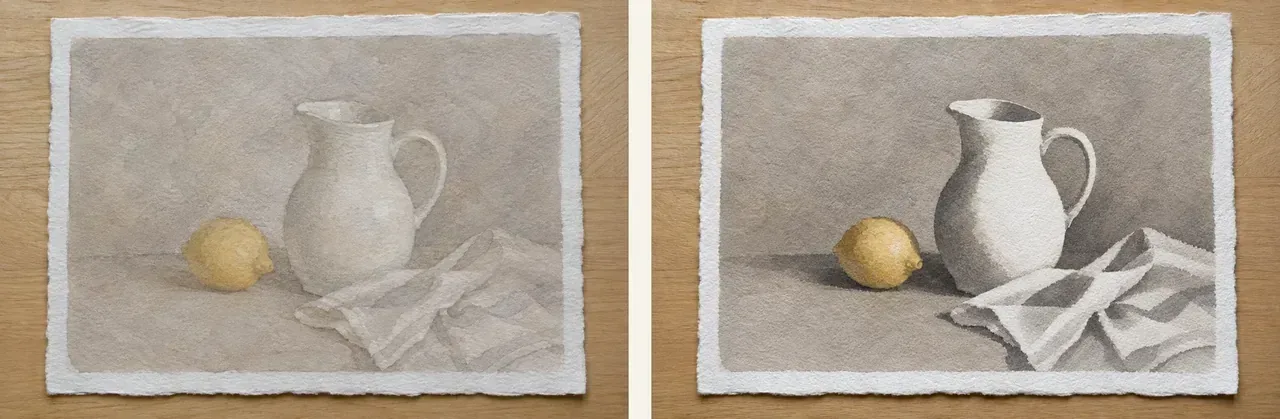
The same colors, the same paper, the same subject. What changed is the gap between the darkest and the lightest.
The digital book "Why Your Painting Looks Flat", to read and apply tonight, with one of your paintings beside you.
Keep reading if you are tired of putting more color on a painting that stays dull:
- Why your painting is not short of colors, and why you are always sent to add more of them, that is, to the one place where there is nothing to fix.
- The pair of pictures and the flip: the one-minute move that takes the color out of the image so you can see what it was hiding from you.
- The three places to look at, and only three: the darkest spot, the lightest spot, and the large middle area nobody ever looks at.
- Why you fix one of them only, the biggest, and why fixing all three at once builds exactly the painting you were trying to avoid.
- What your box loses in darkness as it dries, measured on your own materials, before any conclusion about your materials.
- How to tell, once the fix is done, whether it helped or changed nothing: that question is settled on a new pair, not on a feeling.
Dear reader,
You have a pile of finished paintings. You completed them, you did not ruin them, and still you do not show them. You look at them and tell yourself they are short of light, without being able to say what exactly is missing.
So you do the only thing anyone ever taught you: you put more color in. You brighten a blue, you push a red, you go back over it and it gets worse. The painting gets heavier without getting more alive, and after three passes it is both dull AND dirty.
From: Élise Marchand, for The Paint Method
Place: a kitchen table, somewhere in France
It is not your eye that is bad, it is color that lies to you
What changed everything for me was not a better box. It was giving up on looking at my painting, and starting to measure it.
A flat painting is not a painting without colors. It is a painting where everything sits at the same level: the darkest is not dark enough, the lightest is no longer bare paper, and between the two a large area covers half the sheet without anything standing out in it. As long as the color is there, you do not see it. It is lovely, it keeps your eye busy, and it hides from you that everything looks alike.
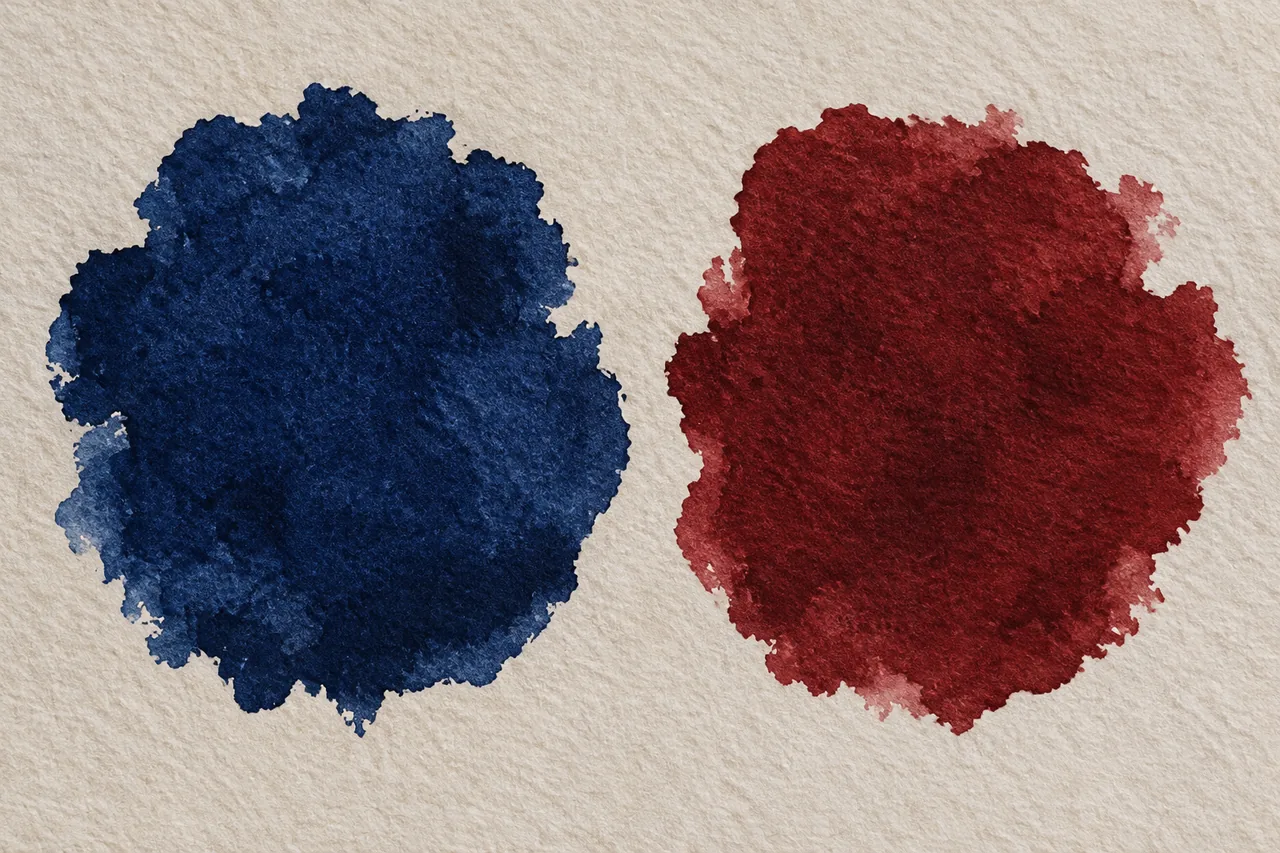
The move takes one minute and there is nothing to install: you photograph your painting and the picture it came from, at the same moment and in the same light, then you turn both black and white on your phone. That is what this book calls the pair of pictures and the flip.
And then you look at three places only. The darkest spot, the darkest place there is. The lightest spot, the lightest place, which in watercolor is almost always paper left bare. And the big middle, the large in-between area nobody ever looks at.
Three places, three comparisons, and one single thing to fix: the biggest of the three gaps. This way of looking costs nothing. You can try it tonight on one of your paintings, before deciding anything on this page. But knowing that dark is missing does not yet tell you where to take it from, how much of it to lay, or how to check afterwards that you have not fooled yourself.
Three places, and one single gap fixed
The darkest spot. Your darkest is almost always lighter than the one in your starting picture, and the black in the pan changes nothing: it promises a dark and gives a flat gray. What steals your dark is water, and it is what color loses as it dries. The book makes you measure that drying loss on your own box, before concluding anything about your materials.
The lightest spot. In watercolor, the lightest is not a color you lay, it is a surface you keep. Bare paper can hardly be taken back, and it is decided before the first color, on a plan of the whites filled in with a pencil.
The big middle. The most common defect and the least visible one: the dark is there, the light is there, and everything else sits at the same level. That is where the painting goes flat, and it is the area nobody looks at.
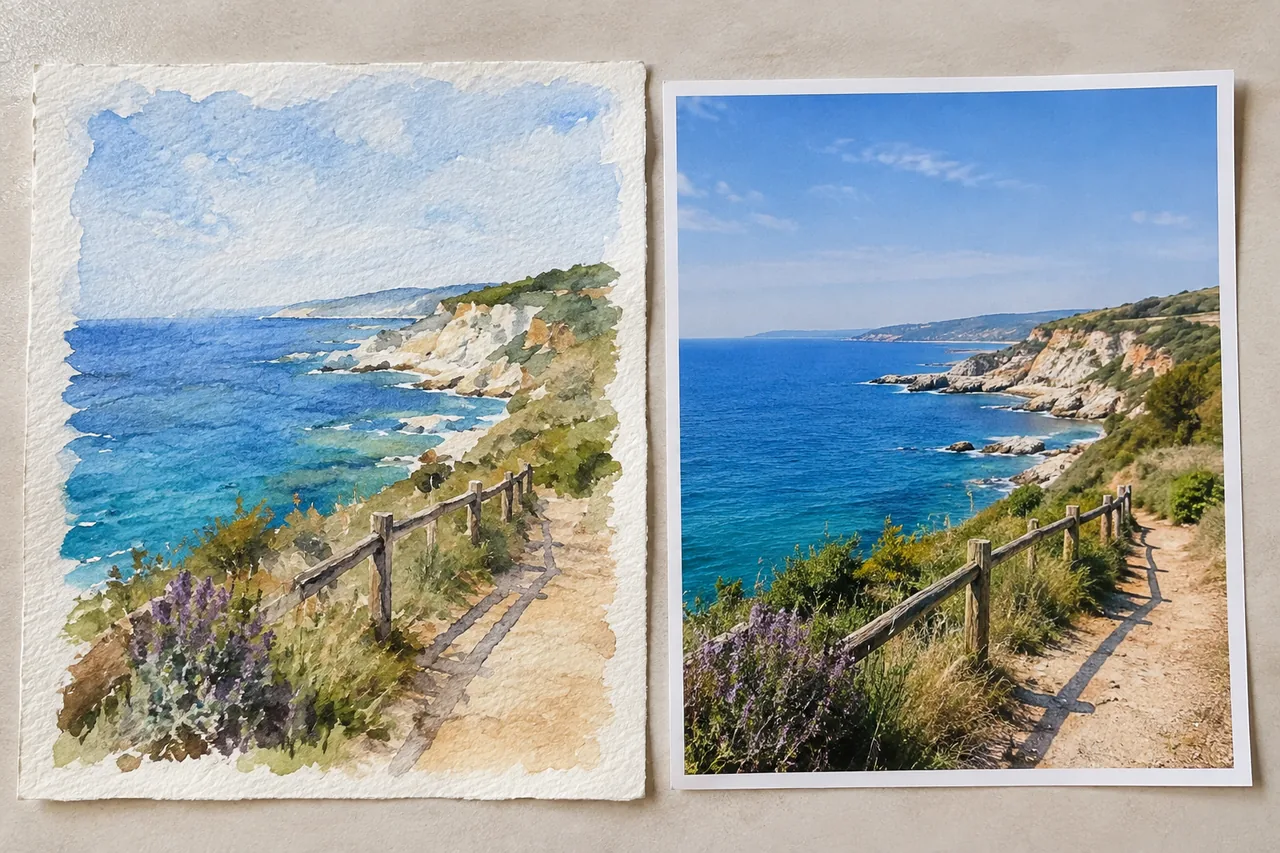
The rule that holds the whole book: you fix one of those three gaps only, the biggest, and once. A check that hands you three fixes to make is a check that builds the painting reworked ten times.
At this point, you have two options
The second option asks for one read and one evening. The first costs a pile of paintings you no longer dare show, and a box you end up putting away.
Imagine
- Imagine looking at one of your paintings and being able to say, in one minute, what it is missing. Not "it is dull": my darkest is three steps too light, and that is the only defect I am going to fix.
- Imagine knowing, before you lay a color, how much lighter it will get as it dries on your paper, because you measured it once and for all.
- Imagine deciding your whites in pencil before the first color, and finding them untouched at the end.
- Imagine fixing one area only, making the pair again, and seeing on the picture that the gap really has shrunk. Or finding that it has not moved, and knowing it straight away instead of pressing on.
What you will be able to do when you close it
- Produce in one minute a pair of flipped pictures of your painting and of your starting picture, with nothing to install.
- Mark on it the darkest spot, the lightest spot and the big middle, and say for each one whether your painting is lighter, darker or the same.
- Point out the biggest of the three gaps, and fix that one alone.
- Get out of your box, exactly as it is, the darkest patch it can give, and say how much too much water you were putting in.
- Announce, before you lay a color, how much lighter it will get as it dries on your paper, and prove it on your filled-in sheet.
- Decide your whites before the first color, and recognize the haze, when the whole painting steps up together and nothing stands out any more.
- Make the pair again after the fix and say, without fooling yourself, whether the gap you aimed at has shrunk and whether the other two have not got worse.
What you need to have, and what you must not buy
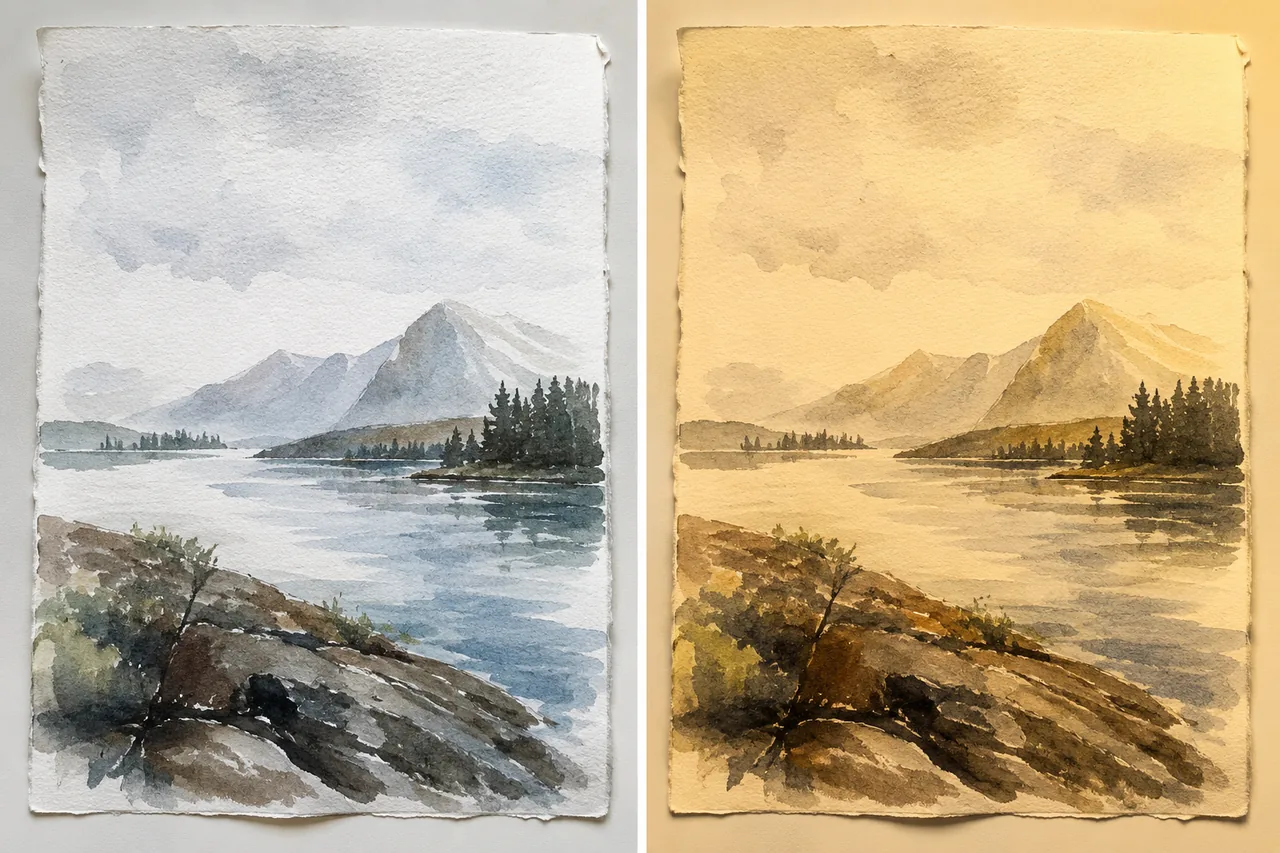
You need nothing more than what you already own. That is a rule I set myself while writing this book, because the most common advice, in front of a dull painting, is to buy better colors. It is the advice that costs the most and settles the least.
The materials list asks you to buy nothing: one painting of your own, dry, that you find flat; the picture it came from, when there is one; your box, exactly as it is, a schoolchild's box included; your brushes, one large and one small; your paper, and offcuts of that same paper; and a pencil. The grain of those offcuts must be the one of your sheet, otherwise the test teaches you nothing about what will happen at your table.
One thing is added to that, and you already have it in your pocket: your phone. It is used to photograph, to turn the picture black and white, and to give you the time when a lesson talks in minutes. It is the only device in this book, no app is named anywhere, and the function that takes the color out is already in the phone.
That is all. No color to buy, no paper to buy, no accessory.
For which materials, and for whom
The book is written for watercolor, and watercolor is what drives the examples. The measurement itself depends on no medium: it looks at a picture and not at a technique, and it holds as it is for gouache and for acrylic. What changes with those two, and the book says so where it matters, comes down to their opacity, that is, to the way they cover: they lay their light with color, where watercolor keeps it as bare paper. Oil is outside this book, its technique resting on layering.
This is for you if you already paint and you finish your paintings. You have a pile of them, you find them dull without being able to say why, and you have already tried putting more color in without anything getting better. No prior knowledge is needed, and you will have no school word to revise.
This is not for you if you have never painted: it is the only book in the collection whose first lesson asks you to have a finished painting at hand, and if you do not have one, that first lesson has you paint one in twenty minutes, on purpose, so that there is something to measure. It is not for you either if you are after a book of ready-made mixes, or a course on composition or on framing: this book does not cover that, it only measures dark and light.
The questions you are asking yourself
"My phone is old, it will not do that." It will. The function that turns a photo black and white has been on every phone for years, and it is the only one this book uses. No app is named, no complicated setting, nothing to install.
"My paints are cheap, that must be it." Maybe, in part. But before buying anything, run the measurement in part 2: five colors laid down, photographed wet and then dry, and the gap written down. You will then know what YOUR box loses, instead of assuming it. The book does not conclude in your place.
"I have tried everything, it will not work." You have tried everything at once: more color, another brush, one more pass. When you change four things at a time, you cannot tell which one counted. This book does not offer you a thirteenth explanation, it offers you a measurement that points at one.
"I do not have the time." The whole move takes one minute, and it is done on a painting that is already dry. The rest you will open when you need it, area by area.
"And if the measurement tells me something I do not know how to fix?" It then sends you to the part of the book that deals with that area, and there are only three of them. The book also says plainly the few questions this measurement does not answer: it does not build a color, it does not tell you when a painting is finished, and it does not save a sheet soaked through.
"I am just not gifted." Nobody is born knowing that a red and a blue with nothing in common can land at exactly the same level. It is not talent, it is information. Nobody gave it to you, and you drew a conclusion about yourself from a silence.
"And if I need help?" You write to contact@thepaintmethod.com. A real address, on this page, before you buy.
I am pleased to introduce my digital book:
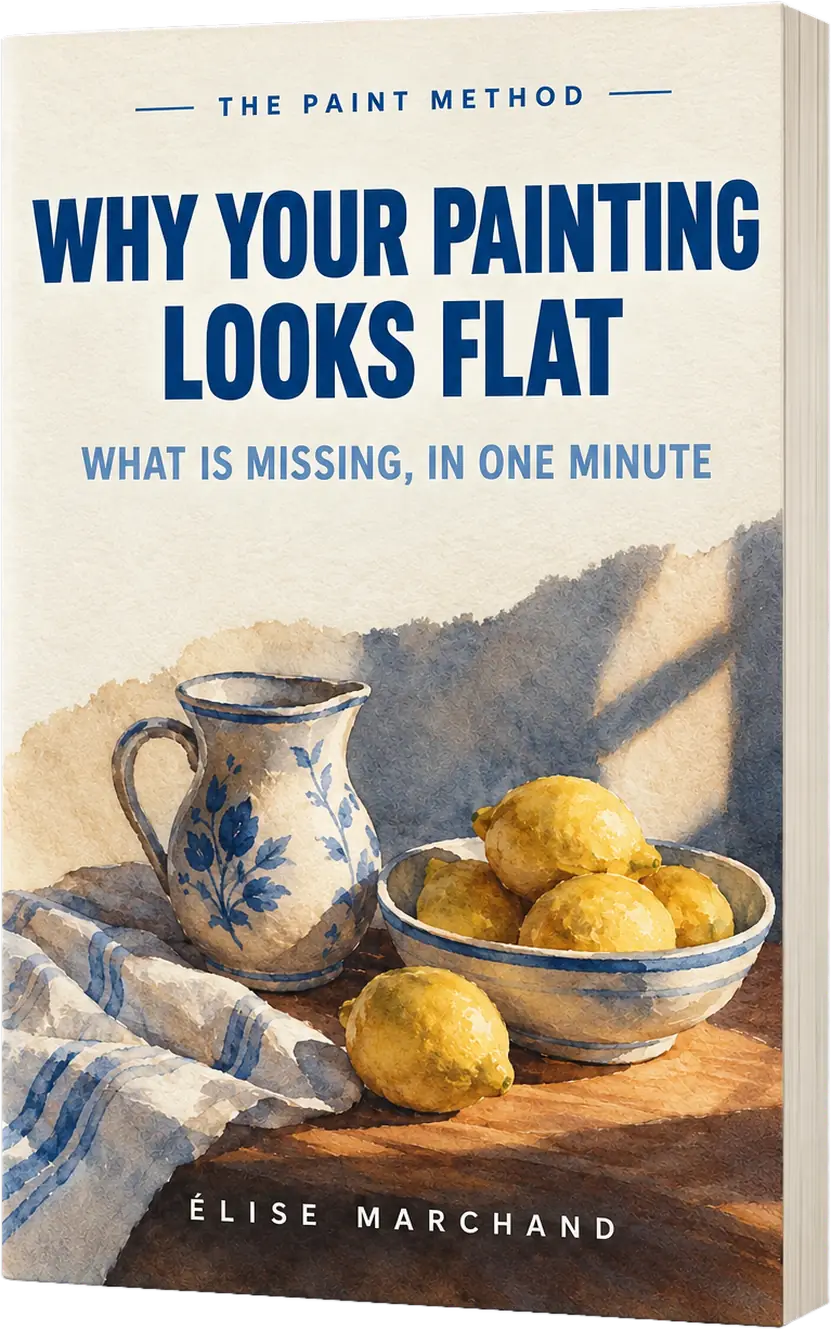
"Why Your Painting Looks Flat"
A digital book in PDF, to read on your phone beside the paper, on your computer, or printed if you prefer paper.
It is built around a constraint I set myself: no black and white picture is ever shown on its own. Every flip appears next to its color original, in the same figure, because it is the comparison that teaches something and never the picture alone. There are sixty-five of them.
Every lesson ends with a line that begins "By the end of this lesson you can", and names something you do, not something you understand. That is what can be checked.
It is written in plain language, with no expert vocabulary. You need nothing but your box, a painting of your own and your phone.
What is inside, part by part
Three lessons. We do not open on a blank sheet: we open on a painting of your own, dry, the one you find flat. The pair of pictures, the flip, the whole move in one minute, and what black and white takes away, which is exactly what was fooling you.
Six lessons. The darkest spot, the lightest spot, the big middle, the sheet filled in with a pencil, and the rule that holds all the rest: one single gap fixed, the biggest. This is where the word value is explained plainly, once, the word you have surely heard without anyone taking the trouble to define it for you.
Six lessons. The black in the pan and what it gives once dry. Water, the first thief of dark. Measuring your drying loss, color by color, on your own box. How much surface a dark really takes up, and why laying too much of it comes to laying none.
Five lessons. Bare paper is your lightest thing, and it is decided before the first color. The three ways of taking back a lost light, with what each one damages. The haze, when the whole painting steps up together. What is called elsewhere a glaze, a color laid over a layer that is already dry, is judged here on one question only: what it costs the light of the paper.
Six lessons. Three grays that look alike make a flat painting. Pushing two neighboring areas three steps apart. Where to put your biggest gap. And what black and white does not say. What is called elsewhere a wash, a broad and very diluted layer, is the first cause of the big middle: it puts a whole surface at one single level.
Six lessons. The same move, done before instead of after: flipping your reference first, the three-level study in ten minutes, the halfway photo, fixing one area without repainting the whole sheet, and the case of the painting made with no starting picture.
Six lessons. Three step-by-step exercises: measure three of your finished paintings and read what comes back; paint a small subject whose three levels were decided before the first color; paint the same subject twice, once without the check and once with it, and lay the two pairs side by side.
The three areas sheet, the six-step strip to paint once and for all with your own box, the drying loss sheet, the plan of the whites, and the six-point check sheet. Plus one example already filled in, with one line left empty and what that triggers.
You don't have to repaint anything to find out what is missing.
The phone in your hand is enough, and the whole thing takes a minute.
Tonight you can set one of your paintings down, run the check, and read plainly what it lacks: the range, the edge, or the transition.
It is not a verdict on your hand. It is a list of three things, and each one can be worked on.
And you?
Which of your paintings goes through the check first?
Your digital book, today
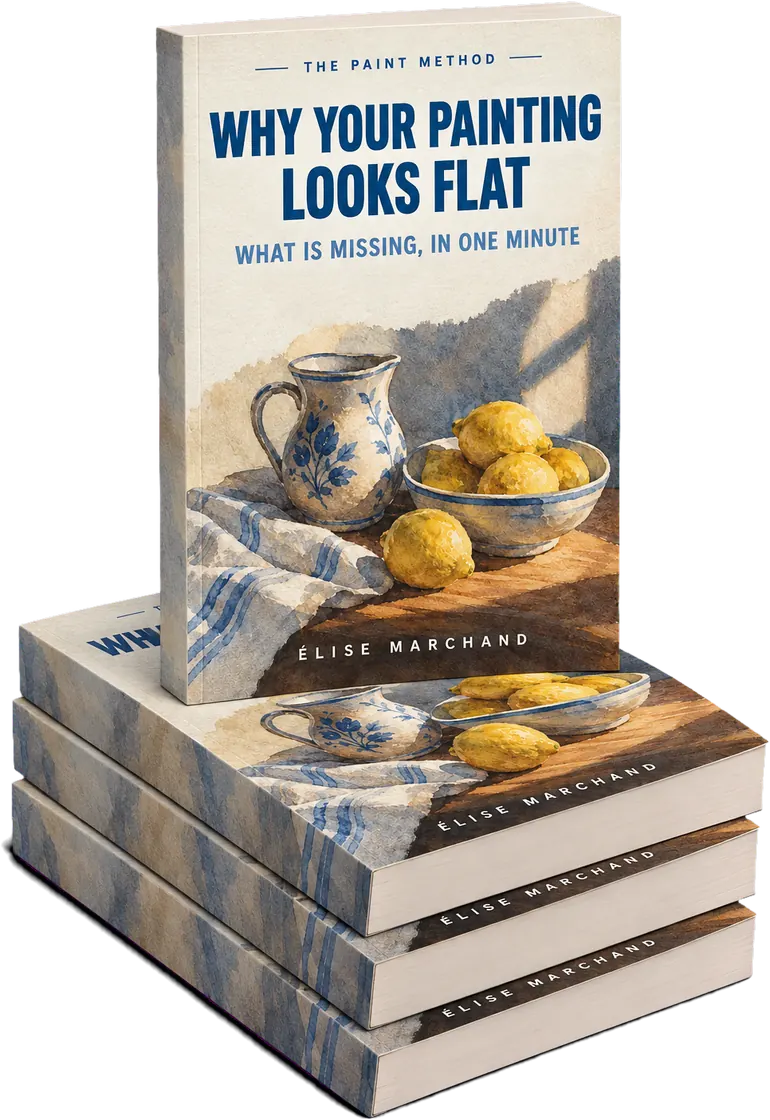
- The complete book in PDF: 38 lessons, 7 parts, 65 color plates (value: $47)
- The five printable sheets, including the six-step strip to paint with the colors in your own box
- The six-point check, to fill in before you lay a wash
- Lifetime access, to read and reread at your own pace, on whatever you like
Value: $47 → today:
The usual price of this book is $47. Today, it is $17.
100% digital access, immediate, and lifetime access. Nothing is shipped.
You get your link by email, within a minute of your order.
30-day guarantee, no conditions
Read the book. Make the pair of pictures on one of your paintings, tonight. Do the three exercises in the last part. If within 30 days you feel it brings you nothing, write to contact@thepaintmethod.com and you are refunded in full.
No form, no justification, no questions. And you keep the book: I would not know how to take it back anyway.
In other words: either you can finally measure what a painting is missing, or this book costs you nothing. The only risk left is closing this page and adding one more painting to the pile.
P.S. If you remember one thing from this page, remember this: as long as the color is on the picture, you cannot see what is missing. Take it away, look at three places, and fix the biggest of the three gaps. Once.
P.P.S. The book is $17 today instead of $47, and it is covered by the 30-day guarantee. You can read it tonight, run the measurement on a painting you already have, and decide afterwards.