How to tell where the gray came from that spoiled your color, by reading it on the dry paper, with no prior knowledge and with the box you already own.
Because a color that turns gray is neither a lack of talent nor a lack of materials: gray is made in three precise places, and each one leaves a different mark on the paper once it is dry. Ten minutes, one of your failed paintings, and you will know which of the three caught you out.
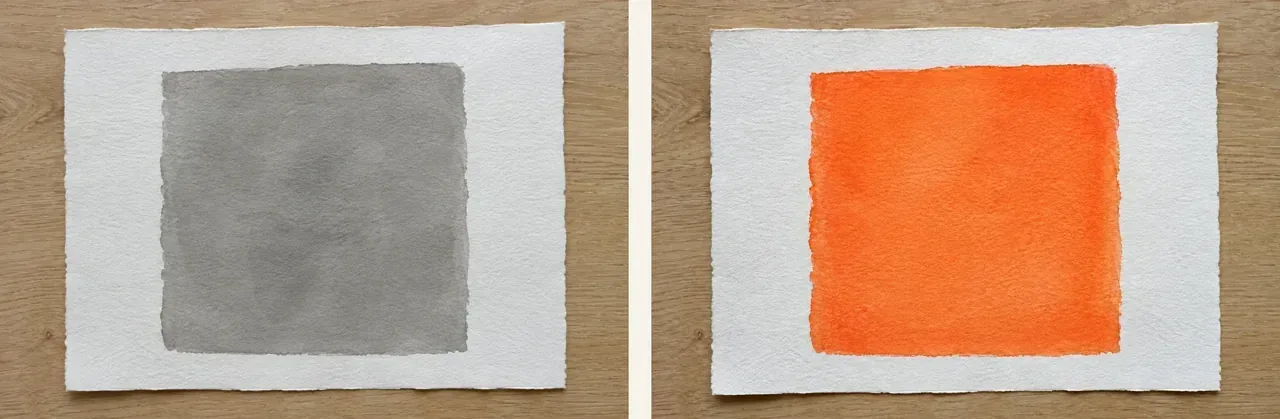
The same two colors, the same paper, the same brush. On the left the mixing went too far and turned gray. On the right it was stopped in time, and the color stayed clean.
The digital book "Why Your Colors Turn Gray", to read and apply tonight, with one of your paintings beside you.
Keep reading if you are tired of starting a painting over because the color turned:
- Why the gray you see was made before the brush ever touched the paper, and why you are always sent to fix it on the sheet, where there is nothing left to fix.
- The three places where gray is made, the well, the puddle and the stroke, and the mark each one leaves as it dries: three pictures to compare with your own painting.
- Why one more color in a mix puts out the first two, and how to spot the two or three colors in your box that dirty everything else.
- The six-point check to run before you lay the last color, the one after which it is too late.
- What to do, in order, when the color has already turned: what can be saved, what cannot, and how to tell them apart.
Dear reader,
You have a paint box. It may be in front of you. It may have been put away for months, since the day you looked at your paper and thought that this was not the color you wanted.
And if you have tried, you know what I mean. You mix, the color looks lovely in the well. You lay it down. It dries. And it is dull, gray, dirty. You add more pigment. Worse. You go back over it to save it. Worse again. After three passes the paper has lost its light and you still do not know what happened.
From: Élise Marchand, for The Paint Method
Place: a kitchen table, somewhere in France
Gray does not happen by accident, it has an address
What changed everything for me was not a better box. It was giving up on asking why the color had turned, and starting to ask where.
Because there are only three possible places. Gray is made in the well, before the brush touches the paper. Or in the puddle, while the color is still wet on the sheet. Or under the stroke, at the moment one pass of the brush comes back over another.
And here is what makes this usable: the three do not look alike once dry. A well gray is even, matt, the same everywhere. A puddle gray has an edge, often a bloom, and it is stronger in one place than another. A stroke gray follows the exact shape of a brush pass: you can see where it starts and where it stops.
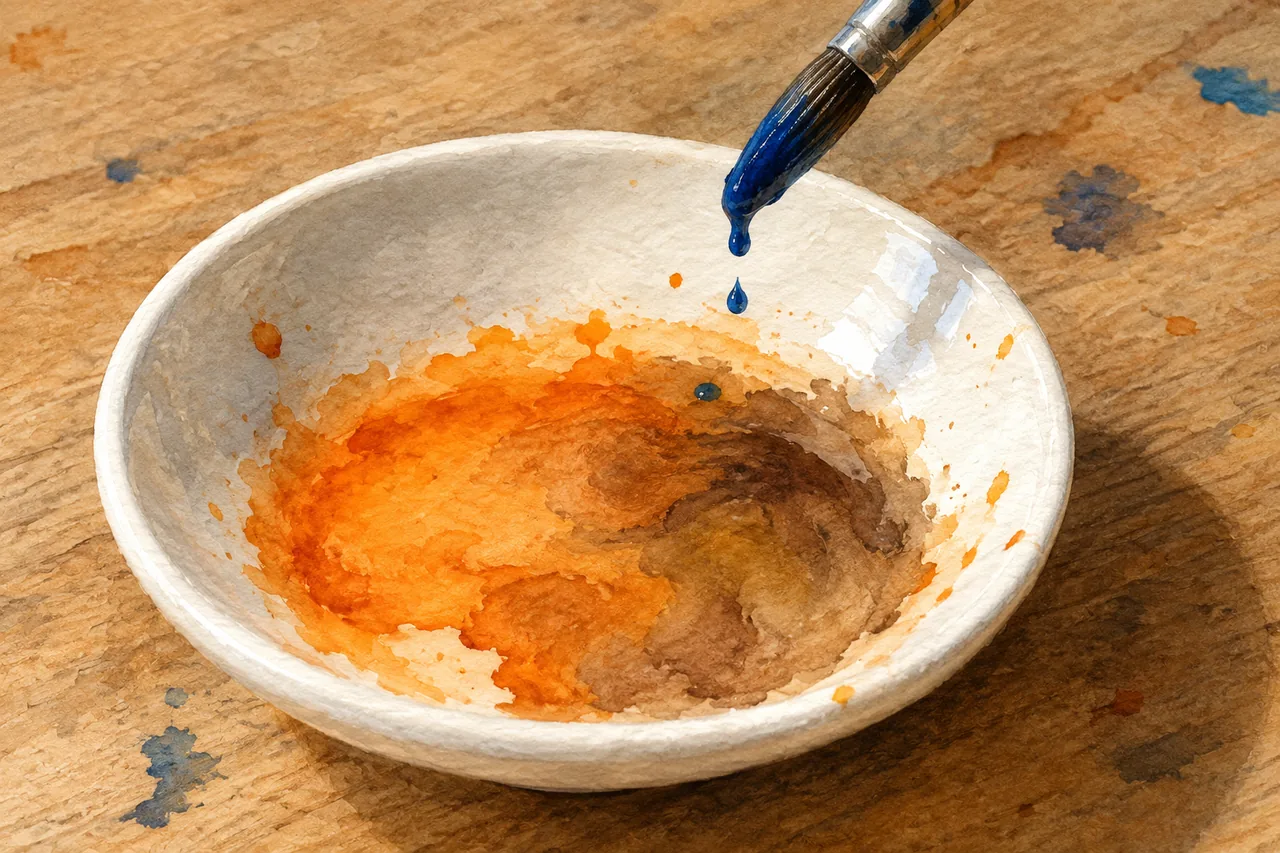
This is the rule that holds the whole book: you name the place before you change anything, because the three remedies have nothing in common. Fixing a well when the trouble is in the puddle is what produces the third pass, and the third pass is what kills the paper.
This way of looking costs nothing. It takes ten minutes. You can try it tonight on one of your paintings, before deciding anything on this page. But recognizing one case is not enough: you need all three, and you need to know which order to treat them in.
The three places, in this order, and not another
The well. The gray already exists before the paper. It almost always comes from the third color added to a mix that held two, or from a pair that puts itself out without your knowing. It shows on a scrap of paper, in three swatches, before you lay anything on the sheet.
The puddle. The gray is made on the paper, while the color is still wet: a layer underneath rising into the one above, a puddle carrying too much water, two colors meeting at the wrong moment. Drying is checked with the back of a finger, at the edge, never in the middle.
The stroke. The gray of the gesture, the one that comes from one pass too many. This book names it and teaches you to recognize it; it does not treat it, because how to lay a stroke and not go back over it is the whole subject of another book in the collection, and I would rather tell you that here than sell you half an answer.
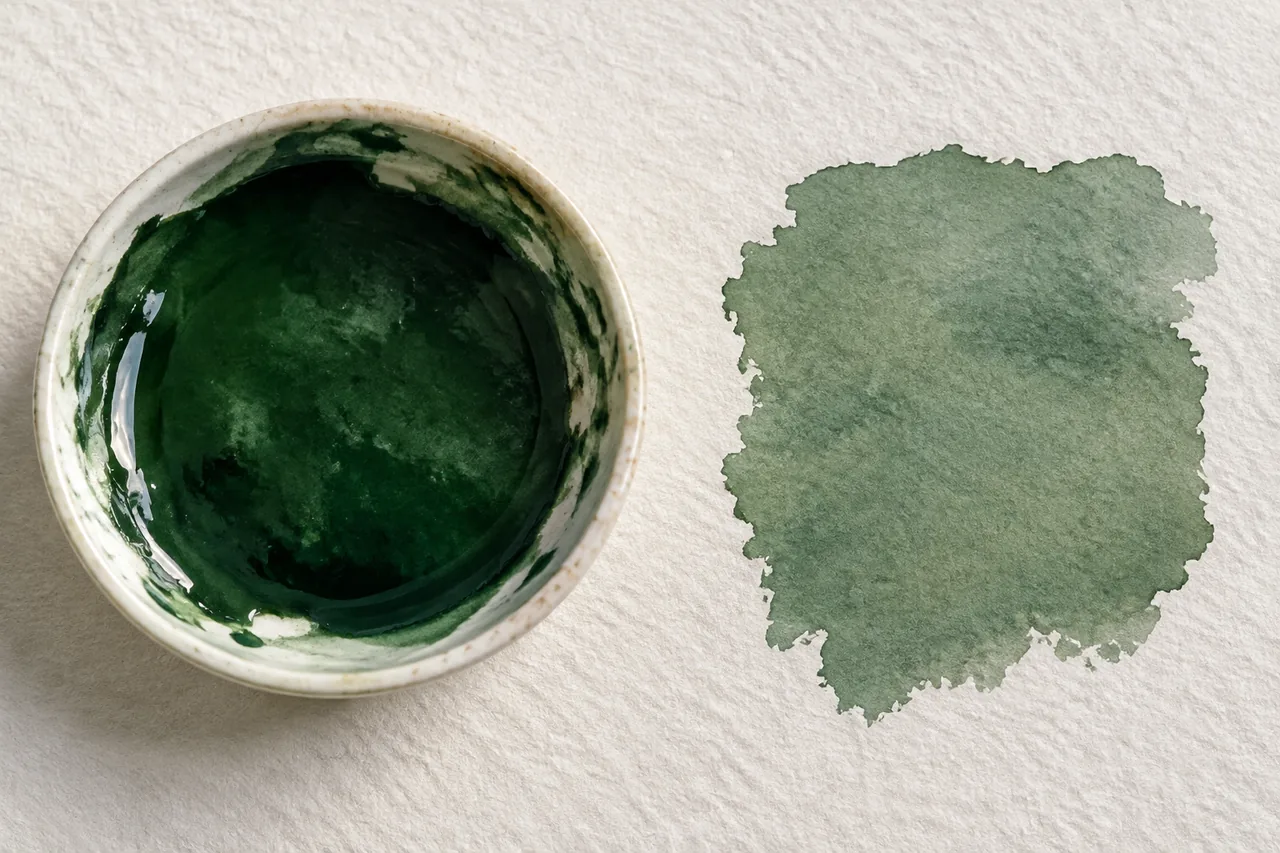
The order matters: you look at the well first, because a gray made there turns up everywhere afterwards, and fixing the sheet is useless while the mix is the cause.
At this point, you have two options
The second option asks for one read and one evening. The first costs paintings you no longer dare show, and a box you end up putting away.
Imagine
- Imagine mixing a color and knowing, before you lay it, whether it will hold or turn, because you tried it on the scrap beside you.
- Imagine looking at one of your older paintings and being able to say, area by area, where the gray was made. Not "it failed": that one is the well, and that one is the puddle.
- Imagine stopping at the right moment, because you have run the six-point check and you know there is nothing left to add.
- Imagine taking your box out on a Sunday afternoon and painting, instead of spending the afternoon trying to rescue.
What you will be able to do when you close it
- Point at the gray areas on one of your own dry paintings and name the place that made each one.
- Stop a mix before the third color, the one that tips it, and prove it on three dry swatches.
- Find, in your own box, the pairs that put each other out, and the two or three colors that dirty everything else for you.
- Check drying with the back of a finger, at the edge, and know what a layer underneath brings up into the one above.
- Recognize a deliberate gray, the useful kind, and know when gray is the right answer.
- Run the six-point check before the last color, and stop on a test rather than on a feeling.
- Take the failed painting you started with, diagnose it, and write down the one thing you will do differently next time.
What you need to have, and what you must not buy
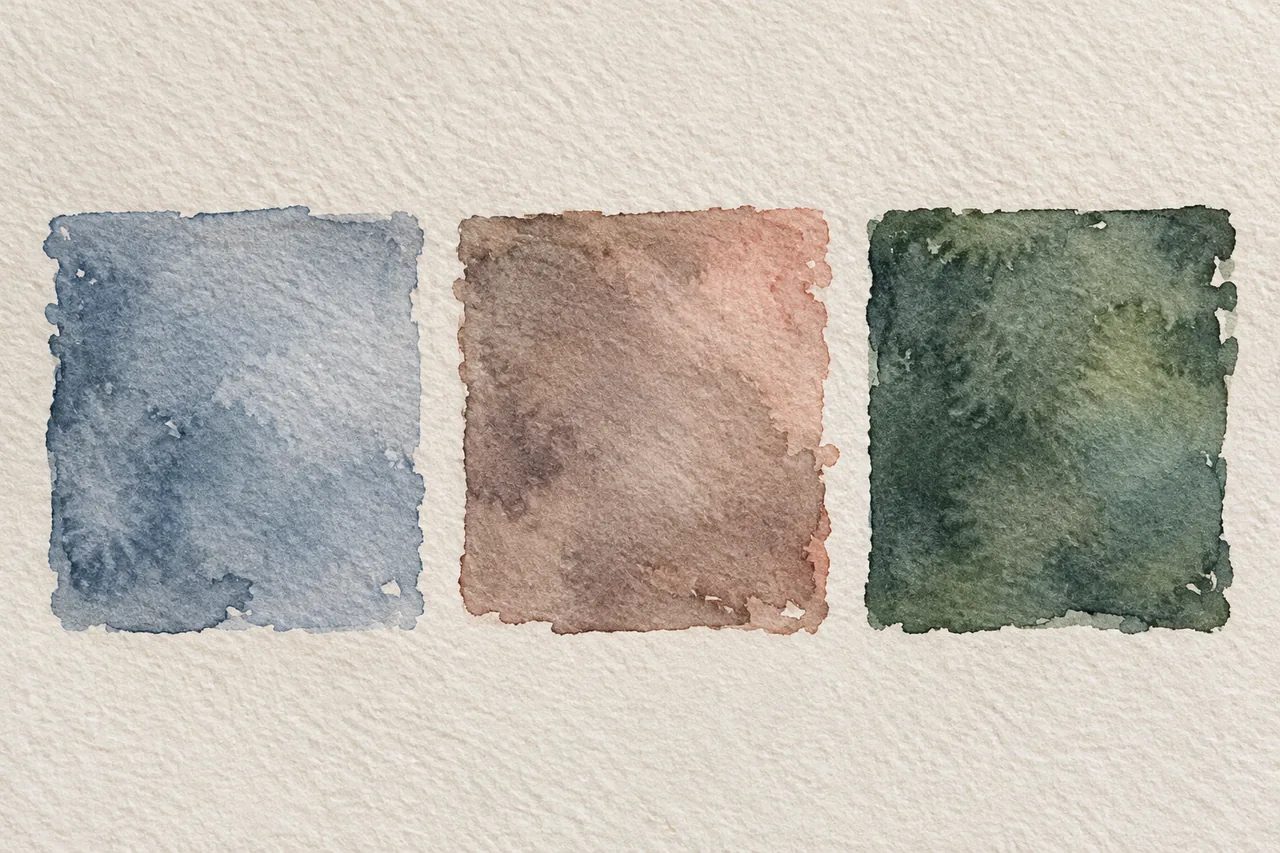
You need nothing more than what you already own. That is a rule I set myself while writing this book, because the most common advice when a color turns is to buy another one. It is the advice that costs the most and settles the least.
The materials list asks you to buy nothing: your box, exactly as it is; a brush; water, in two jars rather than one; and a scrap of the same paper you paint on, kept the same way up from start to finish. The grain of that scrap must match your sheet, otherwise the test tells you nothing about what will happen.
That is all. No color to buy, no paper to buy.
For which materials, and for whom
The book is written for watercolor, and the three places of gray hold in the same way for gouache and for thinned acrylic: three water-based mediums, and gray is made in the same places in all three. What changes from one medium to another is what covers and what lets through, in other words opacity, and the book says so every time it matters. It is not written for oil, where the central move does not apply.
This is for you if you are starting, or coming back after years. No prior knowledge is needed: nothing to revise, no school term to know in advance. You have had a color turn and never understood where it came from. You want to understand what is happening, not learn a list of recipes.
This is not for you if you have been painting for fifteen years and already read your grays. If you are after a book of ready-made mixes: this one teaches you to see, not to copy. If you are after a course on composition or on framing: this book does not cover that, it only deals with the color that dirties.
The questions you are asking yourself
"My box is not the same as yours." That is exactly why nothing in this book rests on a color name. You fill the grid with your colors, and it is your grid that tells you which ones put each other out. It works for good, and it holds only for your box.
"My paints are cheap, that must be it." Maybe, in part. But before buying anything, run the three swatches from the first section. They will tell you whether your gray comes from the well or somewhere else, and in most cases the box has nothing to do with it.
"I have tried everything, it will not work." You have tried everything at once: more pigment, less water, another brush, one more pass. When you change four things at a time, you cannot tell which one counted. This book does not offer you a thirteenth cause, it offers to tell you which of the three concerns you.
"I do not have the time." The diagnosis reads in a quarter of an hour and is run in ten minutes on a painting that is already dry. The rest you will open when you need it, area by area.
"I am afraid of ruining a good sheet." You will not touch your good sheet. Everything happens on a scrap beside you, and that is exactly what it is for: watching it dry before you lay it down.
"I am just not gifted." Nobody is born knowing that a pair of opposite colors cancels out instead of making a new color. It is not talent, it is information. Nobody gave it to you, and you drew a conclusion about yourself from a silence.
"And if I need help?" You write to contact@thepaintmethod.com. A real address, on this page, before you buy.
I am pleased to introduce my digital book:
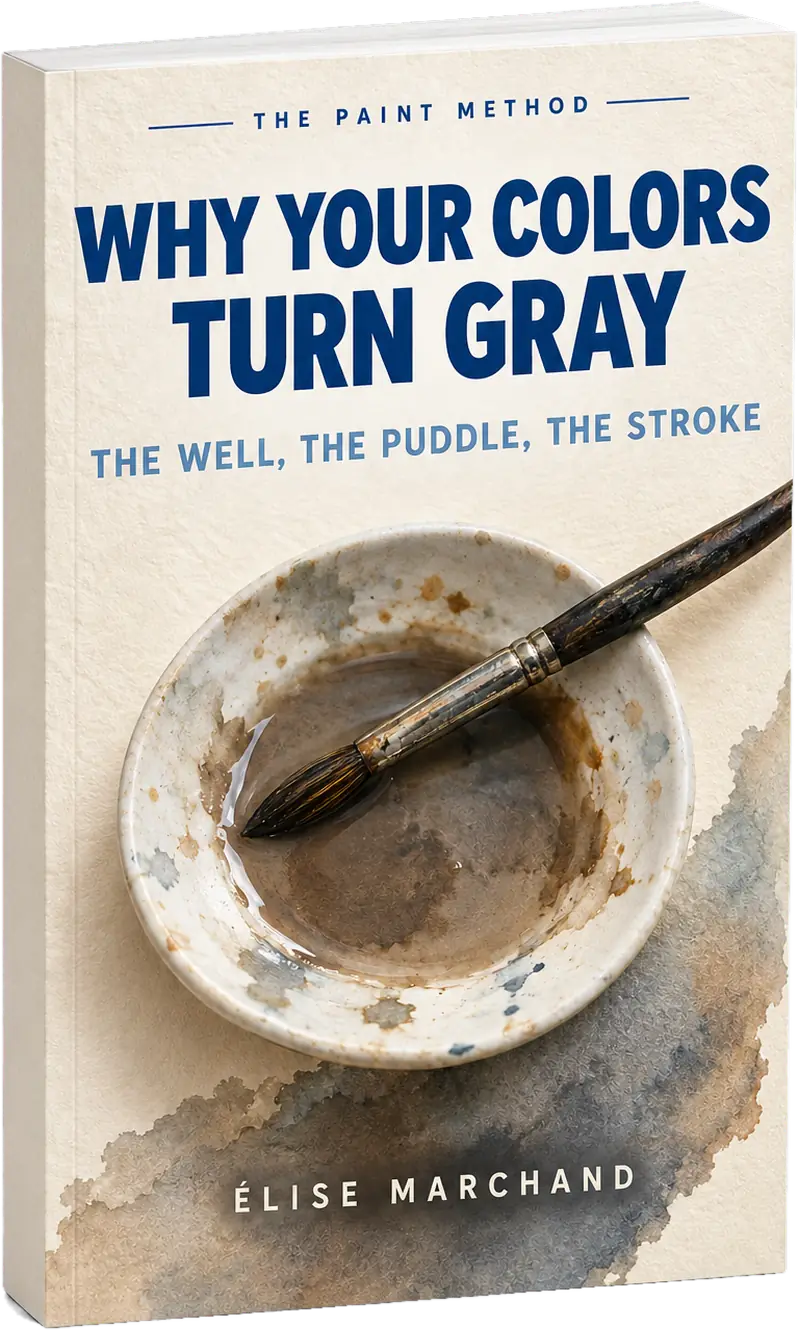
"Why Your Colors Turn Gray"
A digital book in PDF, to read on your phone beside the paper, on your computer, or printed if you prefer paper.
It is built around a constraint I set myself: one picture per case. You have to be able to compare what you see on your sheet with what is on the page, and recognize your gray without having to describe it in words you do not have. There are sixty-eight of them.
Every lesson ends with a line that begins "By the end of this lesson you can", and names something you do, not something you understand. That is what can be checked.
It is written in plain language, with no expert vocabulary. You need nothing but your box, a failed painting and a scrap of paper.
What is inside, part by part
Three lessons. We do not open on a blank sheet: we open on your last failed painting, dry. The three places and their three marks are given in the first pages, and you fill in your first diagnosis on a painting of your own.
Five lessons. The third color and the exact moment a mix tips. The pairs that put each other out, found in your box. The gray water in the rinsing jar, and the pigment left in the heel of the brush.
Six lessons. How long the shine lasts and the dry-finger check. The layer underneath rising. The four dilutions of one color. The bloom and the mud, which are not the same thing. This is where a wash and a glaze are each named once, and explained in plain words.
Three lessons. The third place is named and you learn to recognize it. It is not treated here: how to lay a stroke without going back over it is the whole subject of another book, and this one says so instead of pretending.
Five lessons. Not every gray is an accident. How to make one on purpose that holds, and why it has nothing to do with the one that arrives on its own. This is where values are mentioned, once.
Six lessons. What can be saved and what cannot. The gap between wet color and dry color, noted color by color. And the six-point check, to run before the last color goes down.
Eight lessons. Three step-by-step exercises: dirty the same color by all three routes so you can tell them apart; fill the pair grid with your own box; paint a small motif from start to finish without a single patch of mud, then judge it dry, point by point. We finish on the painting from page one, diagnosed and not repaired.
The three-places sheet, the pair grid to fill in with your colors, the test strip to cut out, the wet-and-dry sheet, and the six-point check sheet.
You don't have to take my word for it: one of your own paintings will do.
It is dry, it is put away somewhere, and you already know which one it is.
Tonight you will be able to set it in front of you and point at each gray patch and say where it was made: in the well where you mix, in the puddle still wet on the paper, or under the stroke of a brush that comes back to the same spot.
It stops being "it went wrong." It becomes an address, and an address can be changed.
And you?
Which painting will you read first?
Your digital book, today
- The complete book in PDF: 36 lessons, 7 parts, 68 color plates (value: $47)
- The five printable sheets, including the pair grid to fill in with the colors in your box
- The six-point check, to fill in before you lay a wash
- Lifetime access, to read and reread at your own pace, on whatever you like
Value: $47 → today:
The usual price of this book is $47. Today, it is $17.
100% digital access, immediate. Nothing is shipped.
You get your lifetime access by email, within a minute of your order.
30-day guarantee, no conditions
Read the book. Run the diagnosis on one of your paintings, tonight. Do the three exercises in the last part. If within 30 days you feel it brings you nothing, write to contact@thepaintmethod.com and you are refunded in full.
No form, no justification, no questions. And you keep the book: I would not know how to take it back anyway.
In other words: either you can finally read your grays, or this book costs you nothing. The only risk left is closing this page and starting one more painting without knowing what happened in it.
P.S. If you remember one thing from this page, remember this: your gray has an address. It was made in the well, in the puddle or under the stroke, and once dry it tells you so itself. As long as you do not know which of the three, you correct at random, and the third pass finishes the job.
P.P.S. The book is $17 today instead of $47, and it is covered by the 30-day guarantee. You can read it tonight, run the diagnosis on a painting you already have, and decide afterwards.