How to put color on a drawing you care about, without it disappearing under the first layer, with the box you already own.
No prior knowledge of painting is needed. What you do need is to know how to draw: this book starts from your own drawings, it does not teach you to make them. Four decisions are taken on the line before the brush touches the paper: which lines stay, the border, the kept white, the first layer. Until all four are taken, the sheet stays dry.
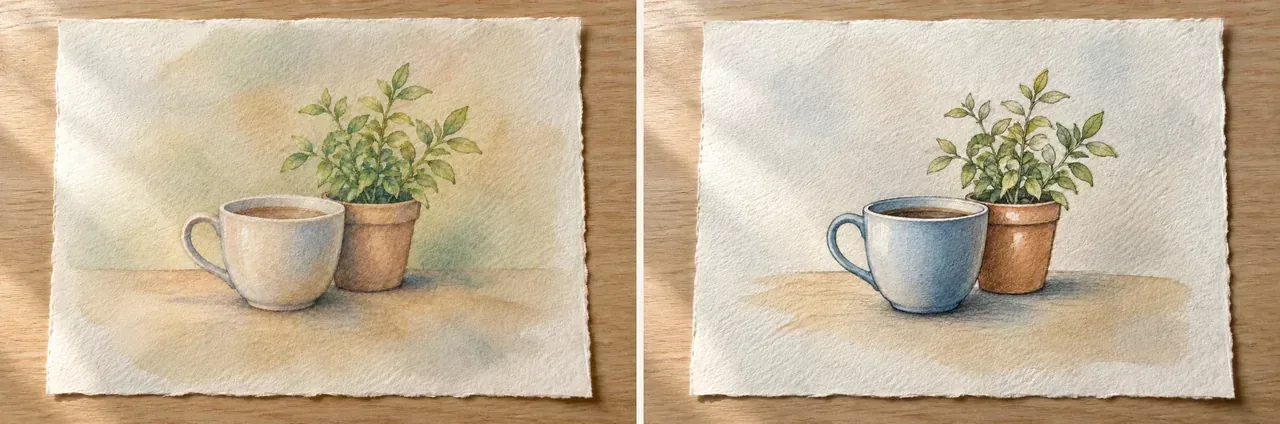
The same subject, the same paper, the same box. On the right, the color is clean and the shadow lifts the cup off the background. Those are the four decisions the book has you write down before the sheet is wet.
The digital book "Adding Color When You Already Know How to Draw", to read and apply tonight, with your sketchbook open beside you.
Keep reading if your drawings stay in pencil because you do not dare touch them:
- Why what stops you is not the color but the moment it meets your line, and why you are always sent back to color lessons that never talk about that moment.
- The four decisions taken on the drawing, before the first layer: which lines stay, the border, the kept white, the first layer. They fit on one sheet, and that sheet is filled in without wetting anything.
- How to separate, on one of your own drawings, the lines that must still read once the color is dry from the ones that only served to build it, and how to lighten the second kind without the paper fluffing up.
- The three places where the color can stop in relation to the line, short of it, on it or past it, and why you already use one of them without having chosen it.
- The six-point check to run before you wet the sheet, the one that stops at the first no.
- What you do when the color has already drowned the drawing: what can be put back, what does not come back, and how to tell the difference.
Dear reader,
You have a sketchbook. There are pages in it you still look at long after making them, and you know exactly which ones.
And then comes the moment when the idea of laying color on one of them stops you cold. Either you close the book and the drawing stays in pencil, or you wet the paper and, an hour later, the drawing you liked is gone. The line has disappeared, the color has run into the white, and you tell yourself that painting asks for something other than what you know how to do.
From: Élise Marchand, for The Paint Method
Place: a kitchen table, somewhere in France
The crossover is settled on the drawing, not in the water pot
What changed everything for me was not mixing better. It was giving up on treating the move into color as a matter of color, and starting to treat it as a run of decisions taken on the line, one at a time, before wetting anything at all.
There are four of them, and they are always the same. Which lines stay: which of your lines must still read once the color is dry, and which ones only served to build. The border: where the color stops in relation to the line, short of it, on it or past it. The kept white: the places that will never take color, circled and counted beforehand. The first layer: what it carries, and what it lets through.
Those four lines fit on one single page, the crossover sheet. It is filled in with a pencil, dry, on a drawing of your own. And that is what makes this book unusual: until the sheet is filled in, the paper does not get wet.
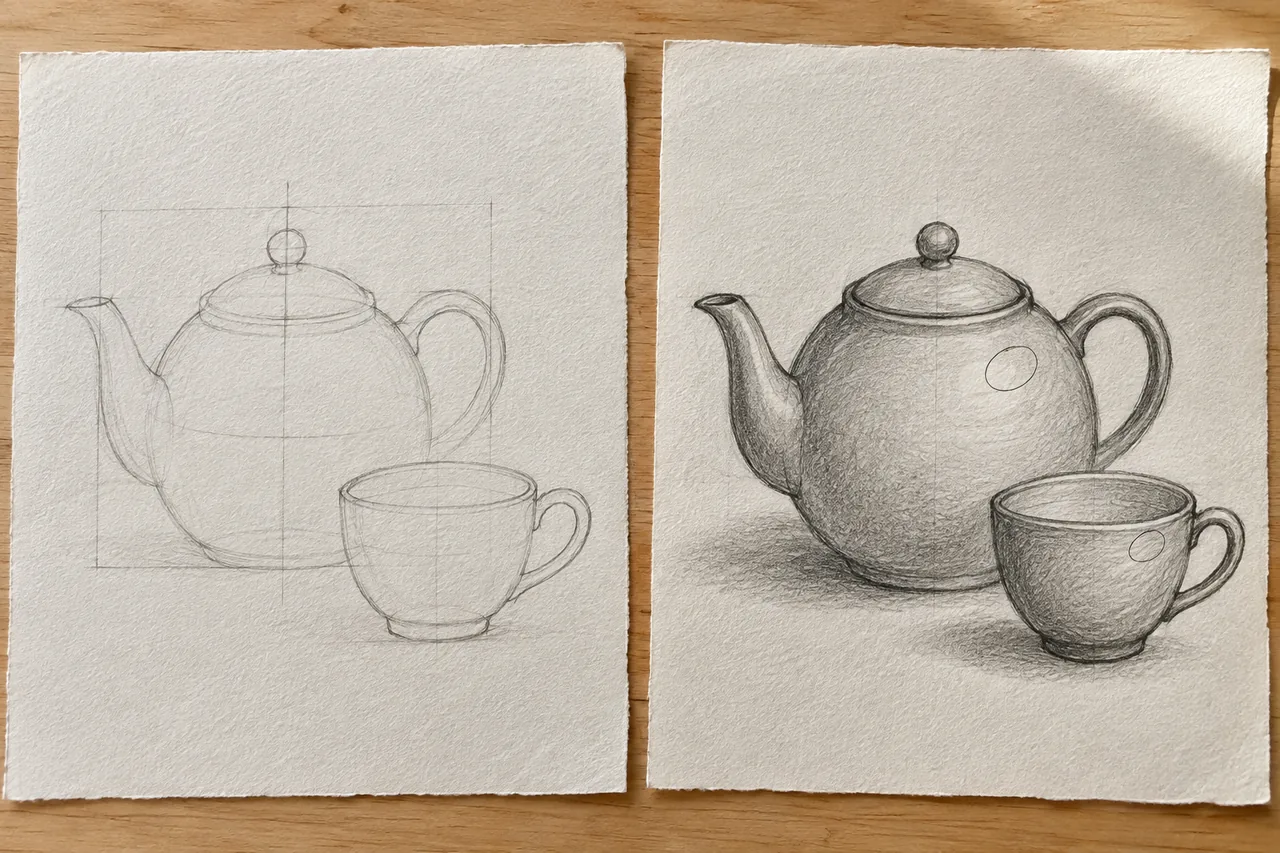
You can try it tonight, before deciding anything at all on this page: pull out three of your drawings and point to the one you never dared put color on. That move is free and it takes ten minutes. But pointing to a drawing is not enough: you need all four decisions, and you need to take them in order.
The four decisions, in this order and no other
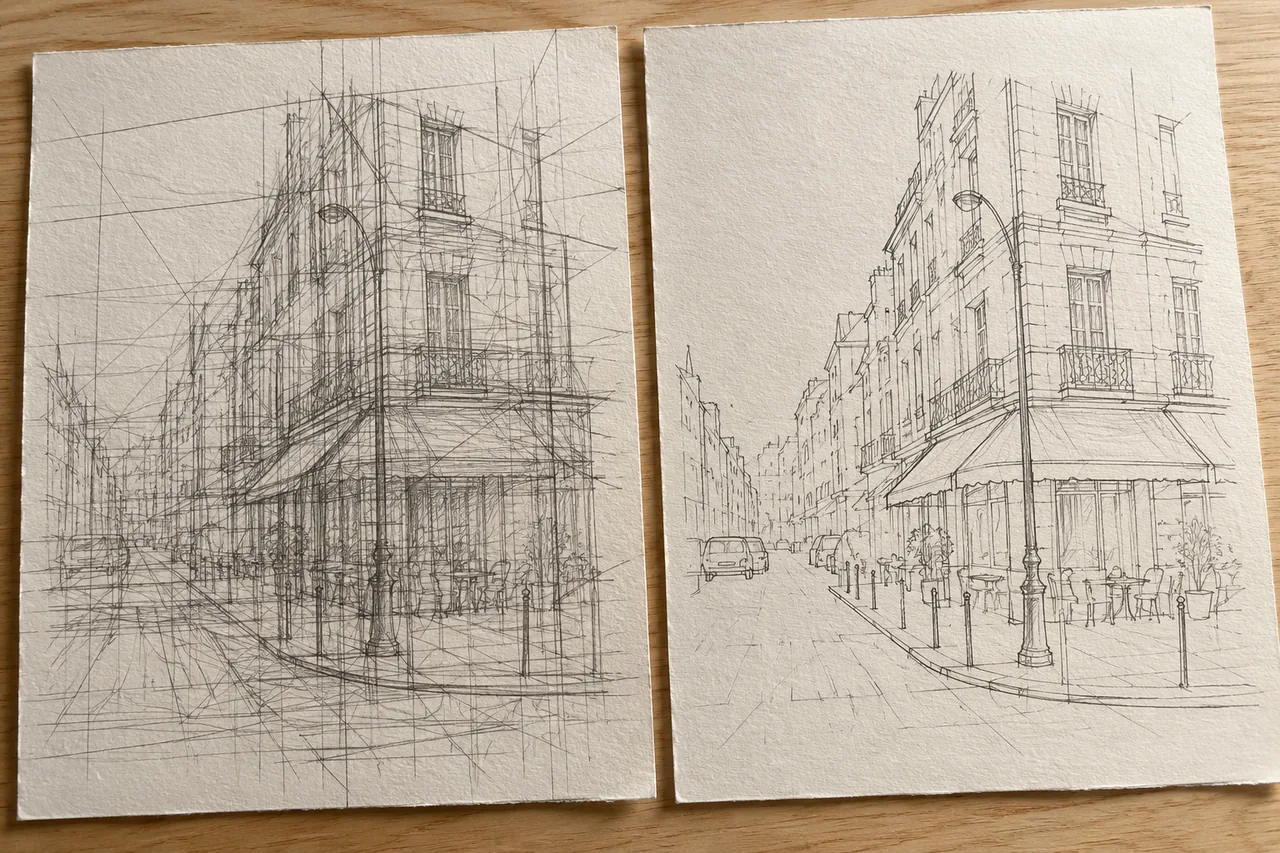
Which lines stay. On your drawing, two kinds of line live side by side: the ones that hold the shape and the ones that served to build it. The second kind is not rubbed out, it is lightened, and that is done with an eraser before any color. This is also where you test your pencils and your inks on a scrap, to find out which ones will go through the color without moving.
The border. The color stops somewhere in relation to the line: visibly short of it, exactly on it, or frankly past it. You already use one of them without having chosen it, and it is often the one that makes a sheet look dirty. The border is decided shape by shape and written down before you load the brush.
The kept white. White is not added, it is kept. The places that will stay white are circled in light pencil and counted before the first layer, otherwise they are lost in three minutes and never come back.
The first layer. It is not the color of the object: it is paler, it holds more water than you think, and it has to let a pencil line read through it. That is tested on a scrap before it is done on the drawing.
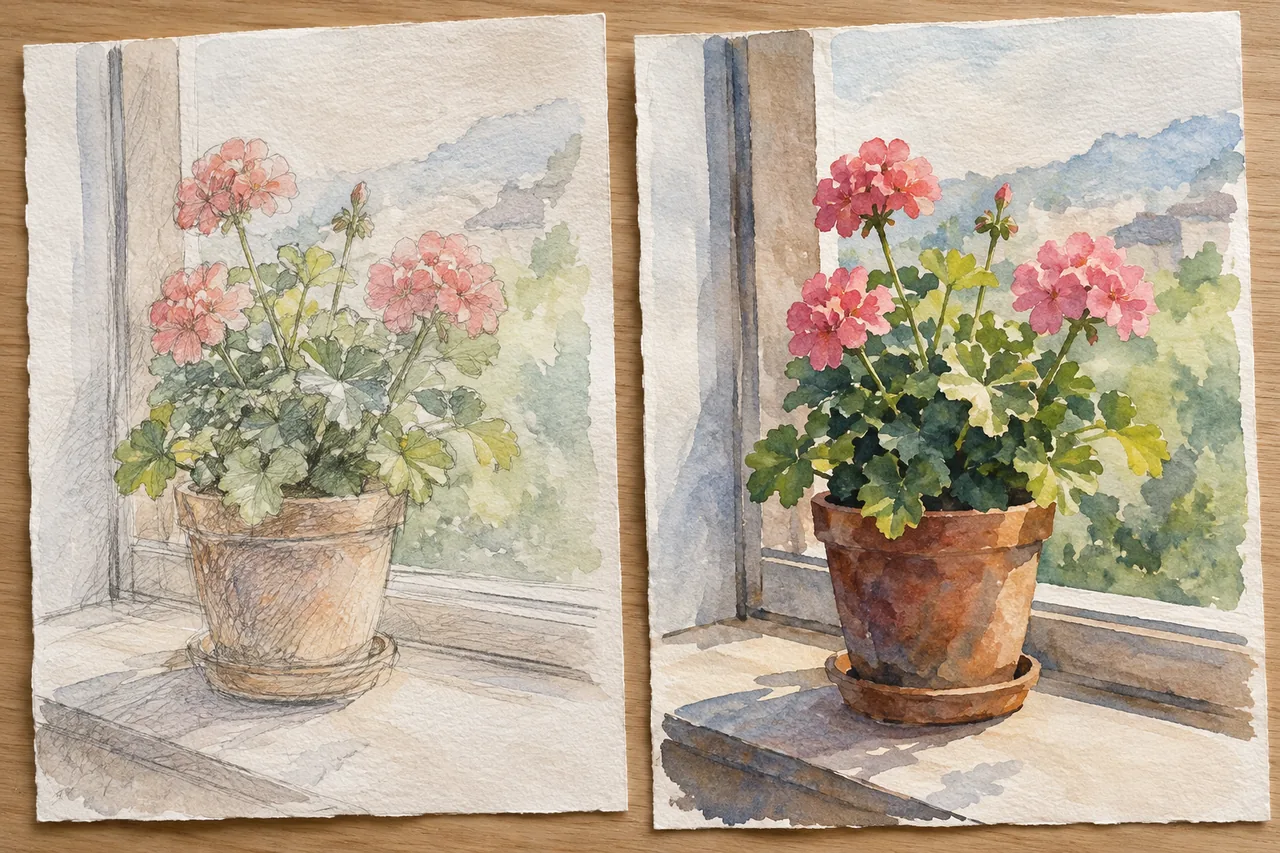
The order matters: a line you have not lightened ends up under all the color, and it is too late to go back to it once the sheet is wet.
At this point, you have two options
The second option asks for one read and one evening. The first costs you a whole sketchbook of drawings you love and will never dare put into color.
Imagine
- Imagine opening your sketchbook at the page you like best and wetting the sheet without being afraid, because the four lines are written down beside you.
- Imagine looking at your drawing once the color is dry and seeing your line still there, in its place, from three feet away.
- Imagine knowing, before you lay anything, where your color is going to stop on each shape, and having written it down.
- Imagine taking up a drawing the color had spoiled, doing the whole thing again, and setting the two sheets side by side.
What you will be able to do when you close it
- Separate, on a drawing of your own, the lines that must still read once the color is dry from the ones that served to build it, and lighten the second kind without the paper fluffing up.
- Say, before wetting anything, which of your pencils and which of your inks will go through the color without moving, tested on a scrap.
- Decide shape by shape whether the color stops short of the line, on it or past it, and write it down before laying it.
- Mark the places that will stay white, count them, and lay a first layer that skips them without going back.
- Get a layer pale enough for a pencil line to read through it, and prove it on a scrap before the drawing.
- Say, sheet dry and set three feet away, whether your line still holds or has drowned, and put back the ones that are missing.
- Take three whole drawings, an object, an animal and a house front, from the pencil through to the end of the first layer, with the four decisions written down.
What you need to have, and what you must not buy
You need nothing more than what you already own. That is a rule I set myself while writing this book, because the most common advice, when a drawing is drowned, is to buy better paper or a better brush. That is the advice that costs the most and settles the least.
The materials list asks you to buy nothing: at least three drawings of your own; the pencil and the eraser you already use; your painting paper exactly as it is, and two different sheets if you have two kinds; offcuts of that same paper, kept beside you; your paints, a brush and a water pot; a pen or a marker if you have one; and a pale wall to stand a sheet against so you can step back three feet. The grain of the scrap has to be the grain of the sheet you will paint on, otherwise the test teaches you nothing.
That is all. No paper to buy, no color to buy, no accessory.
For which materials, and for whom
The book is written for watercolor, and the four decisions hold in the same way for gouache and for diluted acrylic: those are three water-based mediums, and the line is settled at the same moment for all three. What changes from one to the next is what covers and what lets the paper through, that is, opacity: with gouache and acrylic a pale color can be laid back on top, so a lost white can be recovered, and their layers swallow a thin line faster. The book says so every time it counts. It is not meant for oil paint: the whole collection is written for water-based paints.
This is for you if you already draw, even without thinking yourself any good at it, and your sketchbooks are full of pages you never put into color. No prior knowledge of painting is needed: nothing to revise, no school word to know in advance. What this book assumes you already have is the drawing, and nothing else.
This is not for you if you do not draw and are looking to do without it: this book starts from a drawing of your own, and it will not teach you to make one. If you are looking for a course on composition: this book does not give one, it starts from a drawing you have already composed. If you are looking to work on dark and light, what the collection calls values: another book teaches those, under that name, and promising it here would be selling you the same lesson twice.
The questions you are asking yourself
"My drawings are not good enough to be put into color." This book judges no drawing. It works on the crossover, not on the quality of the line, and the very first lesson has you pull out old drawings, including the ones you think went wrong.
"My box is not the same as yours." Nothing here rests on the name of a color or on a brand. The four decisions are taken on your drawing, with your pencils and your sheets, and the tests are done on a scrap of your own paper.
"I have tried already, it runs and the line disappears." You tried changing everything at once: more water, less water, another brush, a heavier line. When you change four things together, you cannot tell which one counted. This book has you take the four decisions separately, and write each one down before you lay.
"I do not have the time." The crossover sheet takes ten minutes to fill in, dry, on a drawing you have already made. The rest you will open when you need it, one decision at a time.
"I am afraid of spoiling a drawing I care about." You will not touch it until the sheet is filled in, and every test is done on a scrap set down beside you. That is exactly what it is for: watching it dry before you lay.
"I can draw but I am not a painter." You can do the one thing most people who paint cannot do. What you are missing is not a talent, it is a run of decisions nobody ever wrote down for you.
"And if I need help?" You write to contact@thepaintmethod.com. A real address, on this page, before you buy.
I am pleased to introduce my digital book:
"Adding Color When You Already Know How to Draw"
A digital book in PDF, to read on your phone beside your sketchbook, on your computer, or printed if you prefer paper.
It is built around a constraint I set myself: one image per case. You have to be able to compare what you see on your sheet with what is on the page, and recognize your own situation without having to describe it in words you do not have. There are sixty-four of them.
Every lesson ends with a line that begins "By the end of this lesson, you can", and names something you do, not something you understand. That is what can be checked.
It is written in plain language, with no expert vocabulary. You need nothing but three of your own drawings, your box and a scrap of paper.
What is inside, part by part
Three lessons. You do not open this book on a blank sheet: you open it on your sketchbook. You pull out three of your drawings, you point to the one you never dared, and you take the four decisions once all the way through, without wetting the sheet.
Six lessons. The keeper line and the working line, recognized on a drawing of your own. Lightening with an eraser instead of rubbing out. The line that has to stay sharp. Testing your pencils and your inks on a scrap, before wetting anything. And the sheet you draw on, which is not always the sheet for color.
Six lessons. The three borders, short of the line, on it, past it, laid side by side and compared once dry. The spill that is not a mistake. The kept white, circled and counted beforehand. And the dry thread between two shapes that touch.
Six lessons. It is not the color of the object, it holds more water than you think, and it skips the places you marked. One layer, then you watch it dry, and you read what it did to your line. And what you do when the layer has drowned the drawing.
Six lessons. A drawing that holds shows at three feet. The line you put back afterward, the one that no longer needs to be there, the one the color swallows. The inked line and what changes. And the drawing too loaded to take color.
Five lessons. A face, an animal, a building or a street, a plant. And the drawing that does not go into color: there are such drawings, and keeping one in pencil is not a failure.
Five lessons. The six-point check, to run before you wet the sheet. Then three drawings carried step by step from the pencil to the end of the first layer: an object on a table, an animal in a lightened pencil drawing, a house front in ink. We close by doing again a drawing the color had spoiled, so as to set the two sheets side by side.
The crossover sheet with its four lines, the line form with its two columns, the strip of three borders, the kept whites form, and the six-point check sheet. They are filled in with a pencil and serve again from one drawing to the next. The crossover sheet is given to you twice already filled in as an example, written out in full.
You don't have to risk a drawing you care about.
A photocopy of that same drawing is enough for the first attempt.
Tonight you will know the order in which to lay the washes so the line stays readable under the color instead of vanishing at the first one.
The drawing you spent hours building is not supposed to be the casualty of coloring it.
And you?
Which drawing will you finally dare to color?
Your digital book, today
- The complete book in PDF: 37 lessons, 7 parts, 64 color plates (value: $47)
- The five printable forms, including the crossover sheet that carries the four decisions
- The six-point check, and the crossover sheet given twice already filled in as an example
- Lifetime access, to read and reread at your own pace, on whatever you like
Value: $47 → today:
The usual price of this book is $47. Today, it is $17.
100% digital access, immediate. Nothing is shipped.
You get your lifetime access by email, within a minute of your order.
30-day guarantee, no conditions
Read the book. Fill in the crossover sheet on one of your drawings, tonight. Carry one of the three crossovers of the last part all the way through. If within 30 days you feel it brings you nothing, write to contact@thepaintmethod.com and you are refunded in full.
No form, no justification, no questions. And you keep the book: I would not know how to take it back anyway.
In other words: either your drawings finally leave the sketchbook, or this book costs you nothing. The only risk left is closing this page and leaving one more page in pencil.
P.S. If you remember one thing from this page, remember this: the crossover is settled on the drawing, not in the water pot. Four decisions, written down before you wet the sheet: which lines stay, the border, the kept white, the first layer. Until all four are taken, laying color is left to chance.
P.P.S. The book is $17 today instead of $47, and it is covered by the 30-day guarantee. You can read it tonight, fill in the sheet on a drawing you have already made, and decide afterward.