How to make brown, beige and gray with two colors you already have in your box, without buying a single one more.
Thank you for taking a minute to read this. A color that turns is neither a lack of talent nor a lack of materials: two colors, one warm and one cool, are enough to make all your browns, all your beiges and all your grays. What changes from one to the next is not a set of formulas to memorize, it is two settings, and you hold them in your hand.
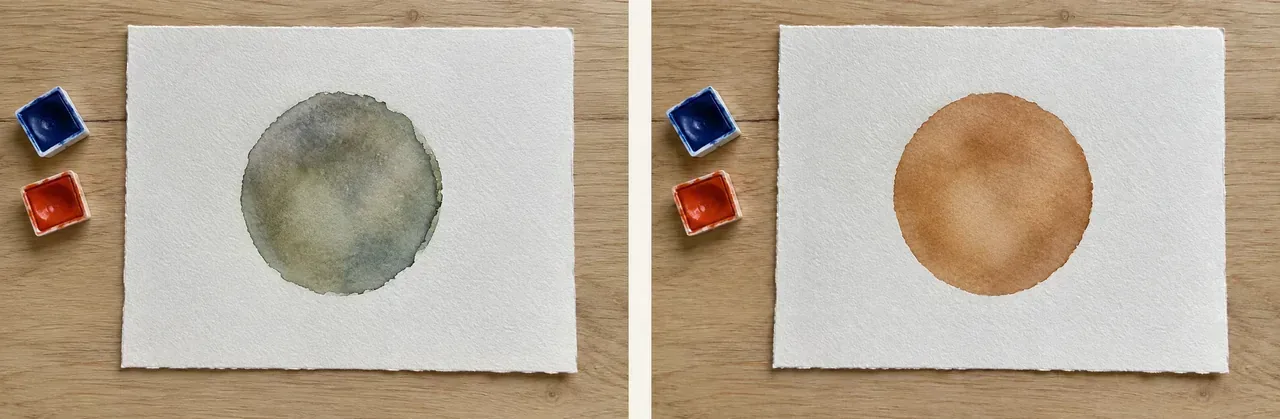
The same two pans, the same paper, the same brush. What changed is how much of each, and nothing else.
The digital book "How to Make Brown (and All Your Beiges) with Two Colors", to read and apply tonight, with your box open beside you.
Keep reading if you are tired of mixing at random and getting something else:
No prior knowledge is needed for what follows: nothing to revise, no school term to know in advance, and nothing to buy.
- Why two colors from your box, one warm and one cool, give you the whole family of your browns, your beiges and your grays, and why a third color does not make that family any bigger.
- How to tell, in a single mix at equal parts, whether two of your own colors make a duo or whether they will stay a pair that gives green.
- The two settings that separate one brown from another: how much of each, and water. You move one at a time, and that is exactly what nobody ever does.
- Why your beige is not a color to hunt for but one of your browns thinned down, and what that changes about the way you mix.
- The three lines to write down at the moment the color is right, so that today's color still exists next week.
Dear reader,
You have a watercolor box. You know how to lay a color on a shape. And you have wanted a brown.
So you know what comes next. You take a blue, you take a red, you add a yellow to save it, and you get khaki. You start again, and it comes out gray. The next day you want the same beige as the day before and you cannot find it. You end up looking for a list of ready-made mixes, or buying one more pan, hoping that this one will be the right one.
From: Élise Marchand, for The Paint Method
Place: a kitchen table, somewhere in France
A color is not hunted for, it is set
What changed everything for me was not a better box, and it was not a list of mixes. It was giving up on asking which color to add, and starting to set what I already had.
Two colors, one warm and one cool. If, mixed at equal parts, they give a brown and not a green or a purple, they make what I call a duo. That duo does not change again. Everything that follows is done with those two pans and nothing else.
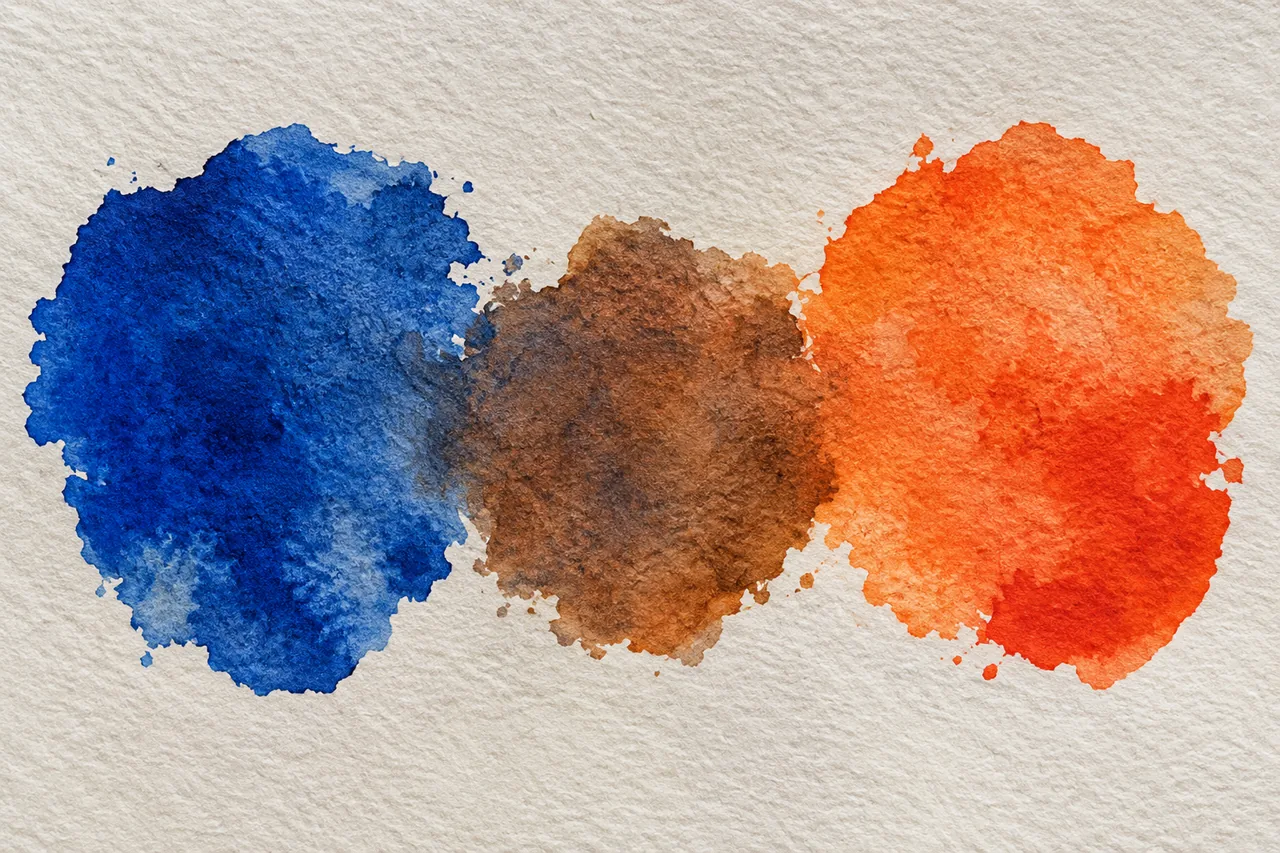
After that, there are only two settings. The mix dial: more warm, or more cool. It gives you your browns on one side, and your grays on the other side of the spot where the duo leans neither way. The water dial: more or less water, so more or less paper showing through the color. It gives you all your beiges, which are nothing but the same brown thinned down.
And one thing remains, the one everyone forgets: a color is yours only on the day you can make it again. Three lines written down at the moment it is right, and it still exists two sessions later.
One duo, two dials, one card. You can try the first mix tonight, before deciding anything on this page. But holding a duo is not enough: you need to know where your browns sit on it, and that is read on dry paper.
One duo, two dials, one card
The duo. Two pans of your own, one warm and one cool, which at equal parts give a brown. If the mix gives a green or a purple, the pair is not a duo, and it is not your fault: one of the two colors already leans toward a neighbor. It shows in one try, on a scrap laid beside you.
The mix dial. Ten mixes going from one color of the duo to the other, on a single strip. Everything your duo can do fits inside it: the zone of your browns, the zone of your grays, and between them the spot where it leans neither way.
The water dial. The same brown, more or less thinned, and the paper showing back up through the layer. That is where your beiges live, your sand, your earth. You do not lighten with white, you lighten with water.
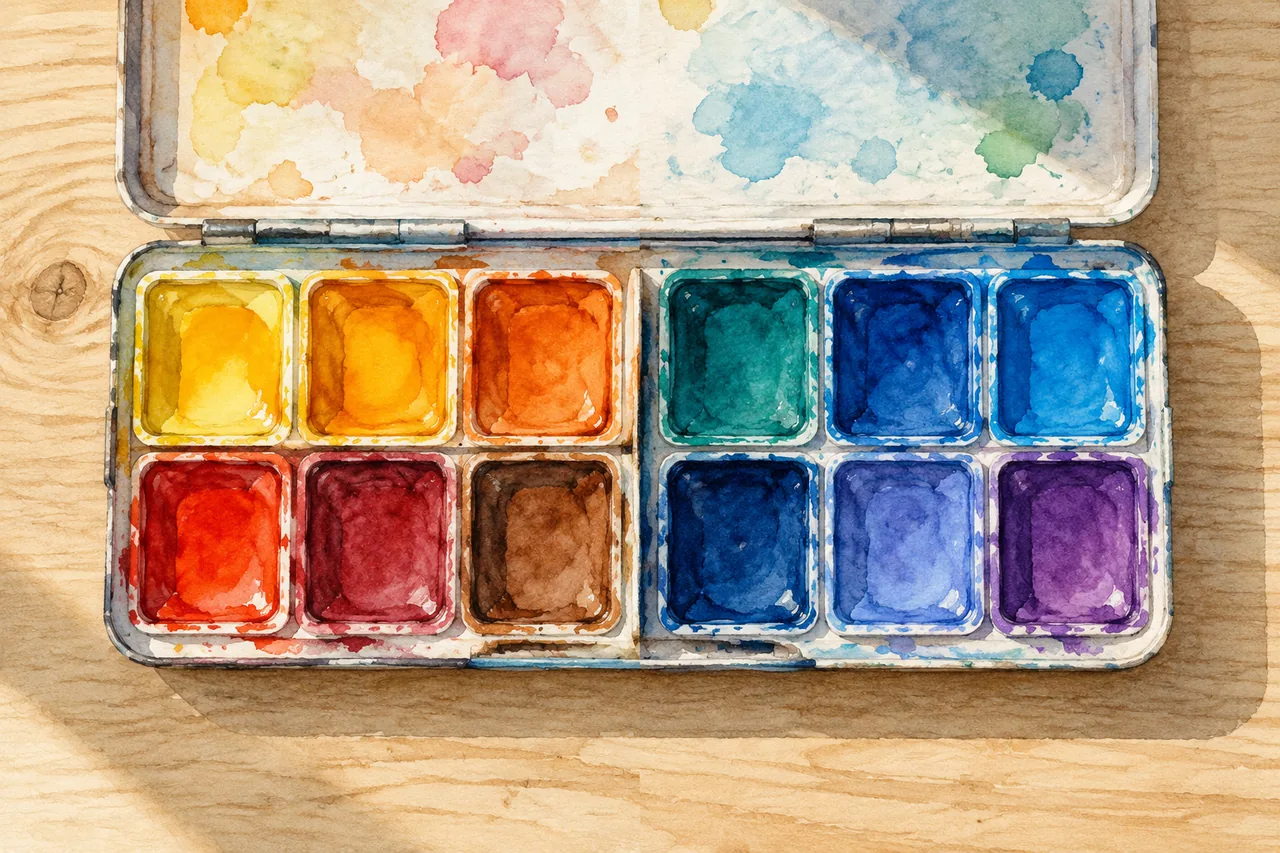
The order matters: you choose your duo first, once, because the two dials are of no use on a pair that gives no brown.
At this point, you have two options
The second option asks for one read and one evening with your box. The first costs pans bought again, mixes lost, and paintings you do not dare show.
Imagine
- Imagine wanting a trunk brown, and pulling it out of your box with two pans, without hesitating, because you know where it lives on your strip.
- Imagine never hunting for a beige again: you take your brown, you add water, and you stop at the place you were aiming for.
- Imagine opening your notebook next week, reading three lines, and making exactly the color you made last Sunday.
- Imagine painting a whole small motif with two pans, and not opening a third one a single time.
What you will be able to do when you close it
- Sort every pan in your box into the warm heap or the cool one, and settle the one you are unsure about without opening a catalog.
- Decide, after a single mix at equal parts, whether two of your own colors make a duo or stay a pair.
- Lay a strip of ten mixes from one end of your duo to the other, and show on it, dry, where your browns are, where your grays are and where the neutral spot is.
- Get a beige by thinning one of your browns, without ever hunting for or writing down a beige recipe.
- Say, before the patch dries, how much lighter it will go, and write that gap down color by color.
- Pull out of one single duo a trunk brown, an earth and a roof, then three beiges, then two grays that look nothing alike.
- Recognize a color your duo will not make, and bring out for that one alone a pan you already own.
- Fill in the three lines of the duo card at the moment the color is right, and make that color again two sessions later.
What you need to have, and what you must not buy
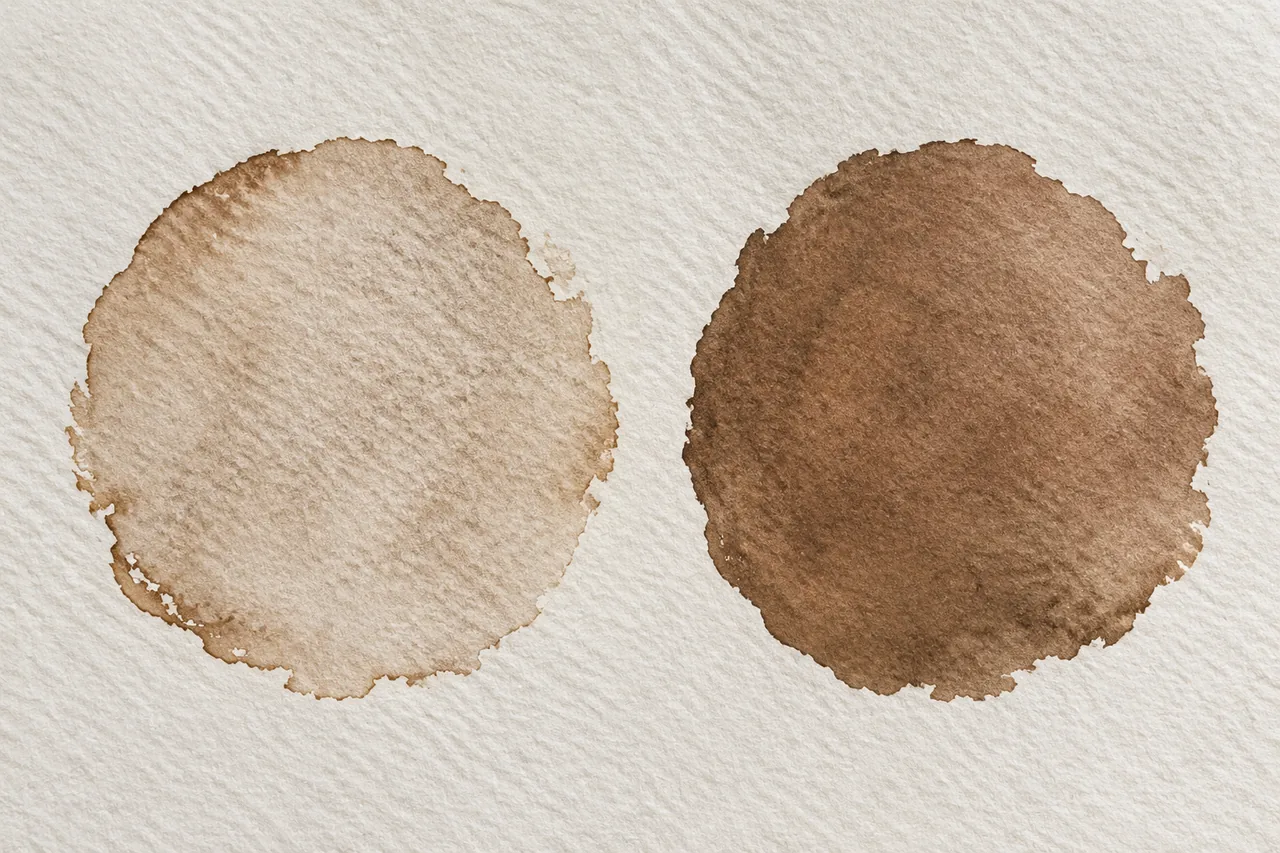
You need nothing more than what you already own. That is a rule I set myself while writing this book, because the most common advice, when a mix fails, is to buy one more color. It is the advice that costs the most and settles the least.
The materials list asks you to buy nothing: your box, exactly as it is; a brush; water, in two jars rather than one; and a scrap of the same paper you paint on. The grain of that scrap must be the grain of your sheet, otherwise the test tells you nothing about what is going to happen.
That is all. No color to buy, no paper to buy, no accessory. And no brand is named in this book: the colors are called by what they do, a warm, a cool, a blue that pulls toward green, a red that pulls toward orange. You work with your box, not with mine.
For which materials, and for whom
The book is written for watercolor, and the duo and the two settings hold in the same way for gouache and for thinned acrylic: three water-based mediums, and a color is made the same way in all three. What changes from one medium to another is what covers and what lets the paper through, in other words opacity, and the book says so every time it matters. It is not written for oil, where you work in layers laid over each other and where a color is not made this way.
This is for you if you already paint with the box you own, you know how to lay a color on a shape, and you have tried to make a brown and got something else. You want to understand how a color is made, not learn a list of mixes by heart.
What this book is not. It is not a course on composition or on framing: it does not cover that. It is not a collection of recipes to copy out. And it is not a book of diagnosis: recognizing where a gray you did not want came from, on a dry sheet, belongs to the first book in the collection, and I would rather tell you that here than sell you half an answer. Here, gray is a color you make on purpose.
This is not for you if you already mix your colors without thinking about it and make them again from one session to the next. You already know most of what is in this book.
The questions you are asking yourself
"My box is not the same as yours." That is exactly why nothing in this book rests on a color name or on a brand. You try your own pans, and it is your grid that tells you which ones make a duo. It is filled in once and it serves for good.
"My paints are cheap, that must be it." Maybe, in part. But before buying anything, run the equal-parts test on three pairs from your box. In most cases you already have a duo in your hand and did not know it.
"I never find my mix again." A whole part of the book answers that. Three things change from one session to the next and none of them shows: the water the brush is carrying, the exact place you were on the mix dial, and the pan that has worn down since. Written down, they stop slipping away from you.
"I have tried everything, it will not work." You have tried everything at once: one more color, less water, another brush. When you change three things at a time, you cannot tell which one counted. Here you move one setting at a time, and you look at it dry.
"I do not have the time." The first test takes ten minutes, pans in hand. The strip of ten is laid in one evening and read again the next day. The rest you will open when you need it.
"I am afraid of ruining a good sheet." You will not touch your good sheet. Everything happens on a scrap beside you, and that is exactly what it is for: watching it dry before you lay it down.
"Two colors cannot possibly be enough." For your browns, your beiges and your grays, they are. For a bright green, a pink or a turquoise, they are not, and the book shows you that instead of promising the opposite: for those colors you bring out a pan you already own, and you never invite it into the duo.
"And if I need help?" You write to contact@thepaintmethod.com. A real address, on this page, before you buy.
I am pleased to introduce my digital book:
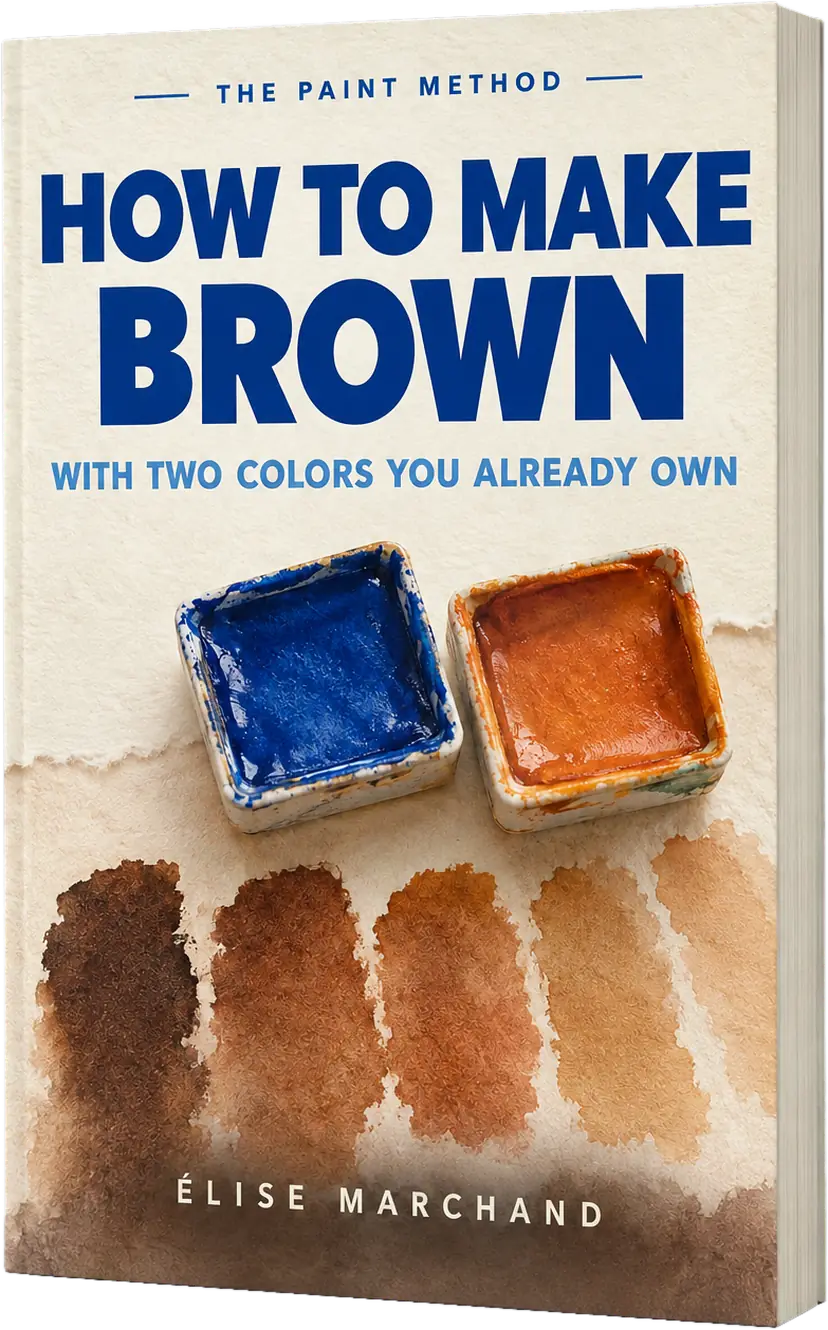
"How to Make Brown (and All Your Beiges) with Two Colors"
A digital book in PDF, to read on your phone beside the paper, on your computer, or printed if you prefer paper.
It is built around a constraint I set myself: every color is made in front of you, with two pans named by what they do. You have to be able to compare what you see on your sheet with what is on the page. There are sixty-six color plates.
Every lesson ends with a line that begins "By the end of this lesson you can", and names something you do, not something you understand. That is what can be checked.
It is written in plain language, with no expert vocabulary. You need nothing but your box, a brush and a scrap of paper.
What is inside, part by part
Three lessons. We open your box and make two heaps, the warms and the cools. Here, and only once in the whole book, the three-color promise is put to the test: the same brown is asked of both methods, on the same sheet, and looked at dry. Then your first brown, with two pans of your own.
Five lessons. Two blues are not the same blue. The equal-parts test, which says in one mix whether a pair is a duo. The pairs that give green, and what that green will be good for. The leaning color. And the duo grid, filled in once and for all with your own box.
Six lessons. The strip of ten, the central move: ten mixes from one color of the duo to the other. Where your browns live, where your grays live, and the neutral spot between them. The warm brown and the cool brown pulled from the same duo. And dosing without counting, on the tip of the brush.
Six lessons. A beige is not a color, it is one of your browns thinned down. Four dilutions of the same brown, and the moment the paper showing through takes over. The beige that goes too yellow, and what to do about it. The gap between wet and dry, written down color by color. And if you are wondering what becomes of the words wash, glaze and values: they are each said here once, in plain terms, and the book does not make them its subject.
Six lessons. Three browns from one single duo: a trunk, an earth, a roof. Three beiges: sand, a wall, skin. Two grays with nothing in common: an overcast sky, a shadow. Black, made or taken from the box, the two laid side by side. What two colors will not do. And darkening without dirtying.
Five lessons. Why yesterday's mix has gone, and which of the three things you are missing to make it again. The duo card, in three lines. Making enough color in one go for a whole area. Reading your card again two sessions later, and adding what you had forgotten to write down.
Seven lessons. Three step-by-step exercises: your strip of ten, then reading it the next day, dry; ten beiges pulled from one single starting mix; and a small motif painted from start to finish with two colors, without opening a third pan, then judged dry on six points.
The blank strip of ten, the duo card in three lines, the duo grid for your own box, the wet and dry card, and the six-point check card, two points of which are blocking.
You don't have to buy one more color to check.
Your box is in front of you, with the colors it already holds.
Tonight you can pull out two pans, lay a test strip, and watch the brown, the beige and the gray you were about to order appear on the paper.
The chart is filled in with YOUR colors, not with a list of names that are not in your box.
And you?
Which two colors will you try first?
Your digital book, today
- The complete book in PDF: 38 lessons, 7 parts, 66 color plates (value: $47)
- The five printable cards, including the duo grid to fill in with the pans in your own box
- The duo card in three lines, and its example written out in full
- The three check exercises, with their test, judged on dry paper
Value: $47 → today:
The usual price of this book is $47. Today, it is $17.
You get lifetime access to the book, to read and reread at your own pace, on whatever you like.
100% digital access, immediate. Nothing is shipped.
You get it by email, within a minute of your order.
30-day guarantee, no conditions
Read the book. Run the equal-parts test on three pairs from your box, tonight. Lay your strip of ten and read it again the next day, dry. If within 30 days you feel it brings you nothing, write to contact@thepaintmethod.com and you are refunded in full.
No form, no justification, no questions. And you keep the book: I would not know how to take it back anyway.
In other words: either you can finally make your colors and make them again, or this book costs you nothing. The only risk left is closing this page and buying one more pan.
P.S. If you remember one thing from this page, remember this: you do not need one more color, you need two colors that go together and two settings. The duo is chosen once. The mix dial gives you your browns and your grays. Water gives you your beiges. And three lines written down give you today's color back next week.
P.P.S. The book is $17 today instead of $47, and it is covered by the 30-day guarantee. You can read it tonight, run the first test with the box you already own, and decide afterwards.